
Safety Glasses and Eye Protection Tips
Eye injuries are among the most common — and most preventable — workplace incidents. According to safety agencies worldwide, the vast majority of eye injuries on the job happen to workers who either weren't wearing eye protection or were wearing the wrong type for the task. For employers and safety managers, that statistic represents both a serious liability and a straightforward opportunity: the right eye protection program, consistently enforced, eliminates most of the risk.
This guide covers everything safety leaders need to know about safety glasses and eye protection — from understanding the standards that govern them to building a program that workers actually follow.
Why Eye Protection Matters in the Workplace
The eyes are one of the most vulnerable parts of the body and one of the least forgiving when it comes to injury. A particle traveling at high speed, a splash of chemical, or a burst of UV radiation can cause permanent damage in a fraction of a second. Unlike a cut on the hand or a bruised knee, serious eye injuries often result in lasting vision impairment or total loss of sight.
Beyond the human cost, eye injuries carry significant operational consequences. Workers who sustain eye injuries typically require immediate removal from the job site, medical treatment, and often extended time away from work. The administrative burden, workers' compensation costs, and reputational impact of preventable injuries add up quickly — and regulators take eye protection compliance seriously.
The Scale of the Problem
Eye injuries in the workplace are not rare events. They happen across industries and job types, from construction and manufacturing to laboratories and healthcare settings. Flying debris, chemical splashes, dust and particulates, intense light sources, and biological hazards all pose real risks to workers who aren't properly protected.
The consistent thread across most workplace eye injuries is that they were preventable. The hazard was known or knowable, appropriate protection existed, and either the protection wasn't provided, wasn't worn, or wasn't suited to the specific task. A strong eye protection program closes all three of those gaps.
Types of Eye Protection
Not all eye protection is the same, and choosing the right type for a given task is one of the most important decisions in an eye protection program. Using the wrong protection — even if it's worn consistently — can leave workers exposed to hazards the equipment wasn't designed to address.
Safety Glasses
Safety glasses are the most common form of eye protection and the appropriate choice for a wide range of general workplace hazards. They look similar to regular eyeglasses but are built to a significantly higher standard — impact-resistant lenses, stronger frames, and side shields to protect against hazards coming from angles as well as head-on.
Safety glasses are appropriate for environments where the primary hazard is flying particles, dust, or debris at moderate velocity. They're commonly worn in construction, woodworking, light manufacturing, and general maintenance work. They are not appropriate for chemical splash hazards, high-velocity projectile environments, or situations requiring full eye and face coverage.
Safety Goggles
Safety goggles provide a sealed or close-fitting enclosure around the eye, offering protection that safety glasses can't match. Because they sit flush against the face, goggles prevent hazards from reaching the eye from any direction — including around the lens and through gaps in the frame.
Goggles are the appropriate choice when working with chemicals, liquids, or fine dust that can enter from any angle. They're standard in laboratory environments, chemical handling operations, grinding tasks that generate fine particles, and any situation where splash or mist is a risk. Some goggles are vented to reduce fogging; others are sealed entirely for maximum protection against liquid hazards.
Face Shields
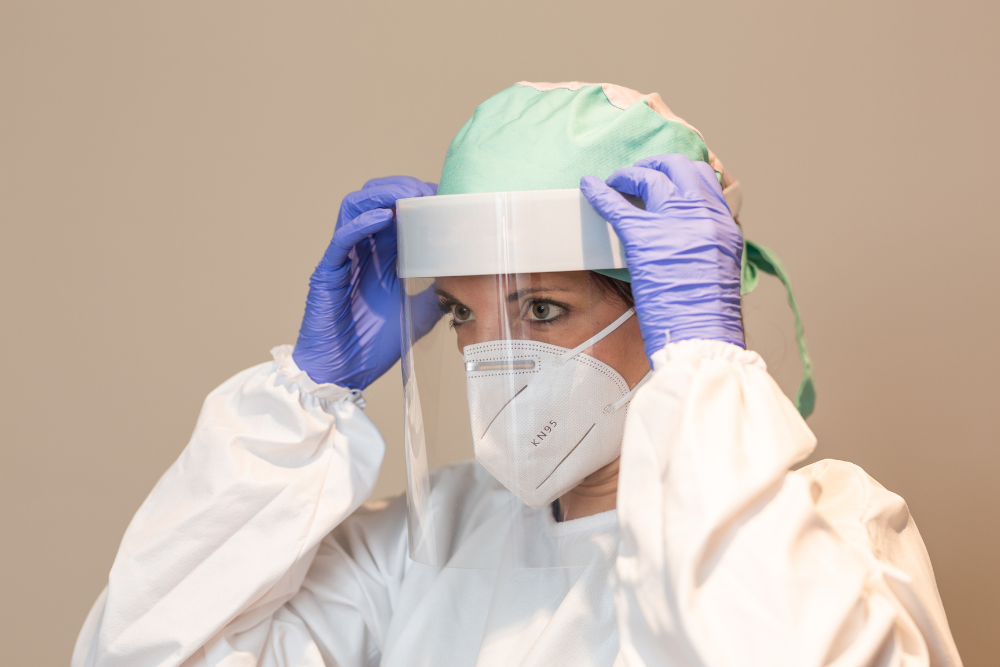
Face shields extend protection beyond the eyes to cover the entire face. They're used in conjunction with safety glasses or goggles — not as a replacement — when the hazard extends to the face as well as the eyes. Common applications include grinding, cutting, chemical pouring, and work involving molten materials.
The key distinction is that face shields alone are not considered adequate eye protection under most safety standards. They should always be worn over appropriate underlying eye protection.
Welding Helmets and Shades
Welding and cutting operations generate intense light, UV radiation, and infrared radiation that can cause serious eye damage — including "arc eye," a painful condition caused by UV exposure that feels like having sand in the eyes. Welding helmets with appropriate shade lenses are required for these tasks, with the correct shade number determined by the type and intensity of the welding process.
Auto-darkening welding helmets have become the standard for many operations, allowing welders to see clearly when not actively welding and providing instant protection when the arc starts. Fixed-shade lenses remain appropriate for high-volume production welding where the shade requirements are consistent.
Laser Safety Eyewear
Laser operations require purpose-built laser safety eyewear designed for the specific wavelength and power level of the laser being used. Standard safety glasses provide no meaningful protection against laser hazards — the lenses need to be specifically engineered to absorb or reflect the relevant wavelength. Using the wrong eyewear, or standard safety glasses, around laser equipment is as dangerous as wearing nothing.
Understanding Safety Standards for Eye Protection
Eye protection sold for workplace use is subject to testing and certification requirements designed to ensure it actually performs as advertised. Understanding these standards helps employers make informed purchasing decisions and helps workers know whether the protection they've been given is appropriate.
ANSI/ISEA Z87.1
In the United States, the primary standard governing eye and face protection is ANSI/ISEA Z87.1, developed by the American National Standards Institute in collaboration with the International Safety Equipment Association. Products that meet this standard are marked with "Z87" or "Z87+" on the lens and frame.
The "+" designation indicates the product has passed high-velocity impact testing, a more demanding requirement than the basic impact test. For most industrial environments, Z87+ rated protection is the appropriate minimum. The standard also covers optical clarity, coverage area, and performance requirements for specific hazard types including UV radiation, infrared radiation, and chemical splash.
EN 166 (European Standard)
In Europe, eye protection is governed by EN 166 and a family of related standards covering specific hazard types. Products are marked with a series of numbers and letters that encode information about the lens type, optical class, mechanical strength, and additional protections against hazards like UV or arc flash. For employers operating in European markets, understanding EN 166 markings is essential to ensuring compliance and appropriate hazard coverage.
AS/NZS 1337
In Australia and New Zealand, eye protection is covered by the AS/NZS 1337 series of standards. Similar in structure to the international equivalents, these standards specify performance requirements for different types of eye protectors and the markings that indicate compliance. Workplaces in these jurisdictions must ensure that eye protection meets the relevant standard for the hazard involved.
What the Markings Mean
The markings on compliant eye protection aren't decorative — they encode specific performance information. Learning to read them means an employer can verify at a glance whether a piece of equipment is appropriate for a given task. At minimum, employers should be able to identify whether protection is impact-rated, whether it carries UV protection, and whether it's designed for liquid splash hazards.
Building an Effective Eye Protection Program
Having the right personal protective equipment (PPE) is necessary but not sufficient. The most comprehensive selection of safety glasses and goggles does nothing for worker safety if it sits in a storage room. An effective eye protection program combines the right equipment with consistent use, proper maintenance, and clear expectations.
Conduct a Hazard Assessment
The foundation of any eye protection program is understanding what hazards workers are actually exposed to. A thorough hazard assessment looks at every task performed in the workplace and identifies the eye hazards associated with each — flying particles, chemical splash, UV exposure, laser radiation, biological hazards, or combinations thereof.
The assessment should result in a clear map of which tasks require eye protection, what type of protection is appropriate for each, and where mandatory eye protection zones should be established. It's not enough to make eye protection generally available and hope workers wear it when they should — the program needs to specify requirements by task and location.
Select the Right Protection for Each Hazard
Once hazards are identified, selection follows logically. The goal is to match the protection to the specific hazard type, ensure it meets the relevant certification standard, and choose products that workers will actually wear. Comfort and fit matter more than many employers realize — workers who find their eye protection uncomfortable will find reasons not to wear it. Involving workers in the selection process, offering choices where multiple compliant options exist, and providing prescription safety eyewear for workers who need it all contribute to consistent use.
Establish Clear Requirements and Enforce Them
Eye protection requirements need to be clearly communicated, consistently enforced, and applied equally across the workforce — including supervisors and visitors. Mandatory eye protection zones should be marked and respected without exception. When workers are observed not wearing required protection, the response should be immediate and consistent. Inconsistent enforcement sends the message that the requirement is optional, which erodes compliance across the board.
Train Workers on Proper Use and Care
Safety glasses and goggles that are scratched, cracked, fogged, or improperly fitted don't provide the protection they're rated for. Workers need to know how to inspect their eye protection before use, how to clean it properly, when to replace it, and how to identify damage that makes it unsuitable for continued use. Training should also cover how to fit goggles and glasses correctly, since poorly fitted equipment provides significantly reduced protection even if it meets the relevant standard.
Replace Equipment When Needed
Eye protection has a service life. Lenses that are heavily scratched reduce visibility and may compromise impact resistance. Foam seals on goggles degrade over time. Straps and frames weaken with repeated use. Employers should establish replacement schedules and make it easy for workers to request replacements when their equipment is showing signs of wear — without making the process so cumbersome that workers keep using damaged equipment rather than go through the effort of getting a replacement.
Common Eye Protection Mistakes
Even well-intentioned programs make predictable mistakes. Knowing what they are makes them easier to avoid.
Using safety glasses for chemical splash hazards is one of the most common. Safety glasses leave gaps around the lens that allow liquids to reach the eye — goggles are required for any task involving liquid chemicals. Relying on face shields alone is another common error, as most standards require underlying eye protection to be worn beneath a face shield. Allowing workers to wear non-compliant sunglasses in outdoor environments is a third — UV protection in sunglasses is not equivalent to impact protection, and standard sunglasses don't meet industrial eye protection standards.
Safety Glasses and Eye Protection: Frequently Asked Questions
What Is the Difference Between Safety Glasses and Regular Glasses?
Regular prescription or fashion eyeglasses are not designed or tested to withstand workplace hazards. The lenses are typically made from materials that can shatter on impact, and the frames are not built to absorb or deflect significant force. Safety glasses, by contrast, are manufactured to meet specific impact resistance standards — in the United States, ANSI/ISEA Z87.1 — which require the lenses and frames to withstand defined levels of impact without breaking or deforming in ways that could harm the wearer. Safety glasses also typically provide greater coverage than regular glasses, with larger lenses and side shields that protect against hazards approaching from angles. Workers who require prescription lenses have two options: prescription safety glasses made to the relevant standard, or safety goggles designed to fit over their regular glasses. Neither option is ideal for all situations, which is why prescription safety eyewear is often the better long-term investment for workers who need vision correction.
How Do You Know Which Type of Eye Protection Is Required for a Specific Task?
The answer starts with a hazard assessment. For each task, identify the specific eye hazards involved — the type of hazard, its likely direction of approach, and the energy or concentration level involved. Flying particles at low to moderate velocity generally call for safety glasses with side shields. Fine dust, chemical liquids, or mists that could approach from any direction call for goggles. Tasks that also generate heat, sparks, or splash that could reach the face call for a face shield worn over goggles or glasses. Welding and cutting require welding-specific eye protection with the correct shade for the process. Laser work requires eyewear specifically rated for the laser's wavelength and power output. When in doubt, the more protective option is almost always the right choice — the cost of over-protecting is minimal compared to the cost of an eye injury.
How Should Safety Glasses and Goggles Be Cleaned and Maintained?
Proper cleaning and maintenance extend the life of eye protection and ensure it continues to perform as rated. Lenses should be rinsed with water or lens-cleaning solution before wiping to remove particles that could scratch the surface — wiping a dry, dusty lens with a cloth is one of the most common ways to introduce scratches. Use soft, lint-free cloths or lens cleaning wipes rather than paper towels, which are abrasive enough to scratch polished lens surfaces over time. Avoid using solvents or cleaning agents not recommended by the manufacturer, as these can degrade coatings or the lens material itself. Foam seals on goggles should be inspected regularly and replaced when they show signs of compression, cracking, or loss of elasticity — a degraded seal compromises the goggle's ability to prevent chemical or dust ingress. Eye protection should be stored in a case or clean area when not in use to prevent damage and contamination.
When Should Safety Glasses Be Replaced?
Safety glasses and goggles should be replaced when they show any of the following: significant scratching that impairs vision or could compromise impact resistance, cracks or chips in the lens or frame, distortion that affects optical clarity, broken or missing side shields, degraded foam seals, or frames that no longer hold their shape and fit correctly. Even without visible damage, eye protection that has sustained a significant impact should be replaced — internal stress fractures may not be visible but can compromise the lens's ability to withstand a subsequent impact. Employers should establish a regular replacement cycle based on the intensity of use and the conditions the equipment is exposed to, and make it straightforward for workers to turn in worn equipment and receive replacements without bureaucratic friction. A worker who hesitates to request a replacement because the process is inconvenient is a worker who continues using compromised equipment.
Are Employers Required to Provide Eye Protection, or Is It the Worker's Responsibility?
In most jurisdictions, the legal responsibility for providing appropriate personal protective equipment — including eye protection — falls on the employer. Regulations in the United States under OSHA, in the United Kingdom under the Personal Protective Equipment at Work Regulations, and in Australia under the model Work Health and Safety laws all place the primary obligation on the employer to identify hazards, select appropriate controls, and provide compliant equipment at no cost to the worker. Employers are also generally responsible for ensuring that workers know how to use and maintain the equipment, that it fits correctly, and that it's replaced when worn or damaged. Workers, in turn, have a legal and ethical obligation to use the protection provided and to report damage or defects. Where workers wish to provide their own eye protection, employers must verify that it meets the required standard for the specific hazard — personal preference is not a substitute for compliance.
.png)


See how SafetyIQ helps simplify EHS management and builds a stronger safety culture.

.png)

.png)