
Choosing and Maintaining Safety Shoes & Footwear
Foot injuries are one of the most underestimated hazards in the workplace. Workers spend entire shifts on their feet, moving across job sites, around heavy equipment, and through environments where a single misstep — or a single dropped object — can cause injuries that keep them off the job for weeks or permanently alter their ability to work. Yet foot protection is frequently treated as an afterthought in safety programs, with workers given little guidance on what to wear, why it matters, or when their footwear needs to be replaced.
For employers and safety professionals, building a proper protective footwear program is one of the most practical investments available. The right safety shoes, matched to the right hazards and worn consistently, eliminate a category of injury that is almost entirely preventable. This guide covers everything you need to know — from understanding the standards to selecting the right footwear for your workforce and building a program that workers actually follow.
What Are Safety Shoes?
Safety shoes are footwear specifically designed and tested to protect workers against common workplace foot hazards. Unlike standard work boots or athletic shoes, safety footwear is constructed to meet defined performance standards covering impact resistance, compression resistance, puncture resistance, and in some cases electrical hazard protection, slip resistance, and chemical resistance.
The term "safety shoes" is often used interchangeably with "safety boots" and "work boots," but in a technical sense, safety shoes typically refers to low-cut footwear while safety boots refers to ankle-height or higher designs. The protection level is determined by the standard the footwear meets, not by the height of the cut — a safety shoe can provide the same toe protection as a safety boot.
What Makes Safety Shoes Different From Regular Work Shoes
The defining feature of most safety footwear is the protective toe cap — a reinforced insert in the toe box designed to protect against falling objects and compression. Traditional steel toe caps have been the standard for decades, but composite and aluminum toe caps are now widely used and offer equivalent or superior protection in specific applications. Beyond the toe cap, safety footwear may include puncture-resistant midsoles, metatarsal guards, ankle support, slip-resistant outsoles, and materials selected for specific chemical or electrical resistance.
Regular work shoes — even heavy-duty ones — don't meet these standards. A worker wearing standard boots on a job site that requires protective footwear is exposed to hazards that their footwear was never designed to address, regardless of how rugged the boots appear.
Safety Shoe and Protective Footwear Standards
Protective footwear sold for workplace use must meet specific testing and certification requirements. Understanding these standards is essential for employers making purchasing decisions and verifying that the footwear they're providing actually protects their workers.
ASTM F2413 (United States)
In the United States, the primary standard governing protective footwear is ASTM F2413, published by ASTM International. Footwear meeting this standard is marked with a label inside the shoe that specifies which protective features have been tested and certified. The label includes a series of designations indicating the type and level of protection provided.
The most common designations include impact resistance (I) and compression resistance (C), which are the baseline requirements for toe protection. Additional designations cover metatarsal protection (Mt), puncture resistance (PR), conductive properties (Cd), electrical hazard resistance (EH), static dissipative properties (SD), and chain saw resistance (CS). Each designation indicates that the footwear has passed specific tests for that hazard type.
CSA Z195 (Canada)
In Canada, protective footwear is governed by CSA Z195, developed by the Canadian Standards Association. The standard uses a grading system based on toe cap material and protective features, with grades indicating the level of impact and compression resistance. CSA-certified footwear displays a green triangle, yellow triangle, or white rectangle depending on the protective features included. The green triangle indicates puncture-resistant soles in addition to toe protection; the yellow triangle indicates toe protection without puncture resistance; the white rectangle indicates toe protection with electrical hazard resistance.
EN ISO 20345 (Europe)
In Europe, safety footwear is governed by EN ISO 20345, which specifies basic requirements for all safety footwear and additional optional requirements for specific hazards. The standard uses an S designation system — S1, S2, S3, S4, S5 — indicating increasing levels of protection and the specific features included at each level. S1 covers basic requirements plus antistatic properties and energy absorption in the heel. S3 adds puncture resistance and a cleated outsole. Footwear certified to EN ISO 20345 displays a CE mark and the relevant S designation.
AS/NZS 2210 (Australia and New Zealand)
In Australia and New Zealand, protective footwear is covered by the AS/NZS 2210 series of standards. These standards align broadly with the ISO framework and specify performance requirements for different categories of protective footwear. Employers in these jurisdictions should verify that footwear purchased for their workforce bears the relevant AS/NZS certification marks.
Types of Foot Hazards and the Footwear That Addresses Them
Selecting the right protective footwear requires understanding the specific hazards workers face. Different environments present different combinations of risks, and the footwear needs to be matched to all of them — not just the most obvious one.
Impact and Compression
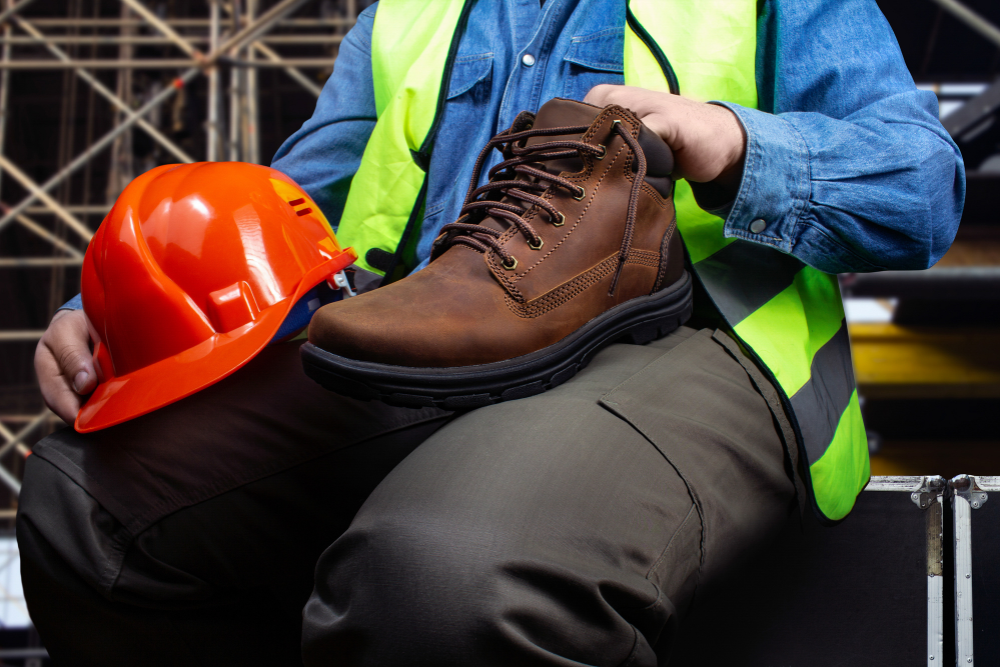
Falling objects and heavy loads are the most common foot hazards in construction, manufacturing, warehousing, and logistics. A protective toe cap — whether steel, composite, or aluminum — is the primary defense against these hazards. The choice between toe cap materials often comes down to secondary considerations: steel toe caps are heavier and conduct heat and cold; composite caps are lighter and do not conduct temperature or electricity; aluminum caps offer a middle ground in weight with good impact performance.
Puncture Hazards
Nails, screws, sharp debris, and other puncture hazards are prevalent on construction sites and in demolition, roofing, and landscaping work. Puncture-resistant midsoles — typically made from steel plate or composite materials — protect the bottom of the foot from penetration. This protection is separate from the toe cap and needs to be specifically verified in the footwear specification.
Electrical Hazards
Workers in electrical trades, utility work, and environments with energized equipment need footwear that addresses electrical hazard exposure. Electrical hazard rated footwear provides a secondary source of insulation against electrical shock when contact is made with live circuits. Static dissipative footwear, by contrast, is designed to reduce static electricity buildup — used in environments where electrostatic discharge could damage sensitive equipment or ignite flammable materials.
Slip and Fall Hazards
Slips and falls are among the leading causes of workplace injury across virtually every industry. Slip-resistant outsoles reduce the risk of slipping on wet, oily, or contaminated surfaces. The slip resistance of a shoe's outsole depends on the rubber compound, tread pattern, and the specific surface and contaminant type it's being used on. No outsole is slip-proof on every surface — understanding the specific floor and contamination conditions in your environment is important when selecting footwear for slip resistance.
Chemical and Liquid Exposure
Workers in laboratories, chemical plants, agriculture, cleaning services, and food processing may face hazards from chemical splashes, corrosive liquids, or prolonged contact with water. Footwear for these environments is typically constructed from materials that resist penetration by specific chemical classes. Chemical resistance needs to be verified against the specific chemicals present in the work environment — a material that resists one class of chemicals may be rapidly degraded by another.
What Are the Most Comfortable Safety Shoes?
Comfort is not a secondary consideration in protective footwear — it's a safety issue. Workers who find their safety shoes uncomfortable will find ways to avoid wearing them, wear them incorrectly, or replace them with non-compliant footwear that feels better. The result is a workforce that is exposed to hazards the footwear program was designed to address.
Why Comfort Matters for Compliance
A safety shoe that causes foot pain, blisters, or fatigue over the course of a shift creates a negative association with PPE that extends beyond footwear. Workers who feel that their safety equipment is being selected for compliance rather than their wellbeing are less likely to engage positively with the broader safety program. Investing in comfortable, well-fitting protective footwear sends a clear signal that the program is designed with the worker in mind.
Features That Affect Comfort
Several factors determine how comfortable a safety shoe is to wear over a full shift:
Fit. Safety shoes should be fitted at the end of the day when feet are at their largest, with the same socks the worker will wear on the job. There should be approximately a thumb's width of space between the longest toe and the end of the toe box.
Weight. Lighter footwear reduces fatigue over the course of a long shift. Composite and aluminum toe caps are significantly lighter than steel, which can make a meaningful difference for workers on their feet all day.
Cushioning and insole support. The quality of the insole affects how the foot is supported over a full shift. Many workers benefit from aftermarket insoles, particularly those with specific arch support requirements or who stand on hard surfaces for extended periods.
Breathability. Heat and moisture buildup inside safety protective footwear is a significant comfort issue. Footwear with breathable uppers and moisture-wicking linings reduces sweating and the associated discomfort and skin issues.
Break-in period. Most quality safety protective footwear requires a break-in period. Workers should be advised to wear new footwear for progressively longer periods before relying on them for a full shift, particularly if transitioning from a different style or brand.
Work Wear Safety Shoes: Matching Footwear to the Job
Different work environments have different primary hazard profiles, and the right footwear choice depends on understanding what your workers are actually exposed to.
Construction and Civil Work
Construction environments combine multiple hazard types simultaneously: falling objects, puncture hazards from nails and rebar, uneven terrain, wet and muddy conditions, and in some cases electrical hazards from site wiring. The standard specification for most construction roles is a safety boot with a rated toe cap, puncture-resistant midsole, ankle support, and a slip-resistant outsole suited to outdoor terrain. For workers near electrical equipment, an EH-rated boot is appropriate.
Manufacturing and Industrial
Manufacturing environments vary widely depending on the processes involved, but common hazards include falling parts and materials, compressed loads from machinery and forklifts, standing on hard concrete floors for extended periods, and chemical or oil contamination on floor surfaces. Safety shoes with toe protection, compression resistance, and slip-resistant outsoles designed for smooth or oily surfaces are typical. Where chemical exposure is present, the outsole and upper material needs to be verified against the specific substances in the environment.
Warehousing and Logistics
Forklift traffic, heavy pallets, and constant movement on hard floors characterize most warehouse environments. Toe protection and slip-resistant outsoles are the baseline requirements. Comfort and lightweight construction matter significantly in this environment because workers cover substantial distances over a shift. Metatarsal protection may be appropriate in environments with frequent forklift operation.
Healthcare and Food Service
These environments prioritize slip resistance above almost everything else, as floors are routinely wet or contaminated with liquids and biological materials. Clog-style safety shoes designed specifically for healthcare and food service environments offer slip resistance, easy cleaning, and chemical resistance to cleaning agents. Toe protection requirements vary by specific role and the presence of falling object hazards.
Building a Protective Footwear Safety Program
Providing the right footwear is only part of the equation. A program that actually protects workers requires clear requirements, proper selection processes, and consistent enforcement.
Conduct a Hazard Assessment
Every protective footwear program starts with a thorough assessment of the foot hazards present in each work area and role. This means walking the job and identifying falling object risks, puncture hazards, slip risks, electrical exposure, and chemical contact — and documenting the findings in a way that can be translated into specific footwear requirements. The assessment should be role-specific rather than site-wide, because different workers in the same facility may face meaningfully different hazard profiles.
Develop a Footwear Specification
Based on the hazard assessment, develop a specification for each role that defines the minimum protective features required. This specification should reference the relevant standard and designations, not just a general description like "steel toe boots." A specification that says "ASTM F2413 rated, I/75 C/75, EH, puncture resistant" is verifiable and auditable in a way that "sturdy work boots" is not.
Involve Workers in Selection
Workers who have input into the footwear options available to them are more likely to wear them consistently. Within the bounds of the specification, offering a range of styles, brands, and designs gives workers some ownership over their PPE. Fit testing — having workers try on multiple options and select the best fit within compliant choices — reduces the comfort-driven non-compliance that undermines many footwear programs.
Enforce Requirements Consistently
Protective footwear requirements need to be enforced consistently across the workforce, including for supervisors, visitors, and contractors. Inconsistent enforcement — where some workers are corrected for non-compliant footwear and others aren't — communicates that the requirement is optional, which is the fastest way to erode compliance across the board.
Establish Replacement Criteria
Safety shoes wear out and need to be replaced. Outsoles that have worn smooth lose their slip resistance. Toe caps that have sustained significant impacts may be internally compromised. Uppers that have developed holes or delamination no longer protect against chemical or liquid exposure. Employers should establish clear criteria for when footwear needs to be replaced and make the process of requesting a replacement straightforward for workers.
Safety Shoes and Protective Footwear: Frequently Asked Questions
What Are Safety Shoes and How Are They Different From Regular Work Boots?
Safety shoes are footwear specifically engineered and tested to protect against defined workplace foot hazards, including falling objects, compression, puncture, electrical exposure, and slipping. The difference from regular work boots isn't primarily in appearance or ruggedness — it's in the internal components and the testing those components have undergone.
A safety shoe contains a protective toe cap rated to absorb a defined level of impact energy without crushing the foot, constructed from steel, composite, or aluminum materials that have been tested to a recognized standard. It may also include a puncture-resistant midsole, metatarsal guard, and specific outsole compounds tested for slip resistance.
Regular work boots, regardless of how heavy-duty they appear, have not been tested to these standards and cannot be assumed to provide equivalent protection. The distinction matters most when a hazard actually materializes — in that moment, the difference between a rated safety shoe and a non-rated work boot can be the difference between a minor incident and a serious injury.
What Are the Most Comfortable Safety Shoes and Protective Footwear for All-Day Wear?
Comfort in protective footwear depends on fit, weight, cushioning, breathability, and the break-in characteristics of the specific shoe — and it varies significantly by individual foot shape, arch type, and the surface the worker is standing on. That said, several factors consistently contribute to comfort over a full shift. Lightweight construction using composite or aluminum toe caps rather than steel reduces foot fatigue meaningfully over the course of a day. Footwear with quality cushioned insoles, or designs that accommodate aftermarket orthotics, provides better support on hard surfaces.
Breathable uppers with moisture-wicking linings reduce heat and sweat buildup. For workers who spend most of their shift on their feet, the investment in a higher-quality safety shoe with better cushioning and arch support tends to pay off in reduced fatigue and fewer musculoskeletal complaints over time. Employers who allow workers to try multiple options before committing to a specific model see better compliance and fewer complaints than those who issue a single standard across the workforce regardless of fit.
Does Nike Make Safety Toe Shoes?
Nike has produced safety toe footwear under the Nike SFB and other work-oriented lines, though their footwear product range changes regularly and availability varies by region. For workplaces with formal safety footwear requirements, the critical consideration isn't the brand — it's whether the specific model meets the required standard for the hazards present. A Nike safety shoe that meets ASTM F2413 with the appropriate designations for your workplace is compliant; one that doesn't meet the standard is not, regardless of brand recognition.
Workers who prefer athletic-style footwear should look for safety shoe options from brands that specialize in blending athletic design with protective performance standards. Several manufacturers now produce safety shoes in athletic and lifestyle silhouettes that meet full protective footwear standards — these can improve compliance among workers who resist traditional safety boot designs.
Where Can Employers Buy Protective Footwear in Bulk for Their Workforce?
Safety protective footwear for workforce programs is available through industrial safety distributors, direct from manufacturers through their commercial or fleet programs, and through online safety supply platforms. For large organizations, establishing a direct relationship with a manufacturer or regional distributor typically provides better pricing, consistent product availability, and the ability to set up a managed footwear allowance program where workers select from pre-approved compliant options. Safety shoe distributors in specific regions — including Texas and other states with large industrial workforces — often provide on-site fitting services for large workforce programs, which improves fit quality and reduces replacement rates from workers choosing incorrect sizes. Employers should prioritize suppliers who can provide documentation of compliance with the relevant standard for each model, as this simplifies auditing and demonstrates due diligence in the event of a workplace injury.
How Often Should Safety Shoes Be Replaced?
There is no universal replacement interval for safety shoes because wear rates depend heavily on the environment, the intensity of use, and the specific footwear construction. The practical answer is: replace when the protective features are no longer intact. Outsoles that have worn through the tread pattern should be replaced because they no longer provide their rated slip resistance. Toe caps that have sustained a significant impact from a falling object should be replaced even if the shoe appears undamaged, because the cap may have absorbed its designed impact energy and may not perform to standard in a subsequent incident. Uppers with holes, separation, or delamination no longer provide protection against liquid or chemical ingress. Beyond damage-based replacement, most employers implement a time-based replacement policy — typically annual replacement for high-use environments, every 18 to 24 months for lighter-use roles — as a baseline even when visible wear has not yet triggered replacement. Workers should be encouraged to report footwear condition regularly and to request replacement before damage becomes severe.
Are Safety Shoes Required by Law?
In most developed jurisdictions, employers are legally obligated to identify foot hazards in the workplace and provide appropriate protective footwear when those hazards are present. In the United States, OSHA's personal protective equipment standards require employers to assess hazards, select appropriate PPE, and provide it to workers at no cost in most circumstances.
In Australia, the Work Health and Safety laws impose a similar obligation to manage risks, which in practice means providing appropriate footwear where foot hazards are identified. In the United Kingdom, the Personal Protective Equipment at Work Regulations require employers to provide PPE where risks cannot be adequately controlled by other means.
The specific type of footwear required depends on the hazards present — the legal obligation is to match the protection to the risk, not simply to require any form of safety shoe. Employers who require workers to provide their own protective footwear without reimbursement, or who fail to specify and enforce appropriate footwear requirements, are generally in violation of applicable regulations and take on significant liability in the event of a foot injury.



See how SafetyIQ helps simplify EHS management and builds a stronger safety culture.

.png)

.png)