
OSHA Lighting Standards for Facilities
Learn OSHA lighting standards, foot-candle requirements by work area, and how to keep your workplace safe and compliant. Includes industrial lighting guidelines and FAQs.
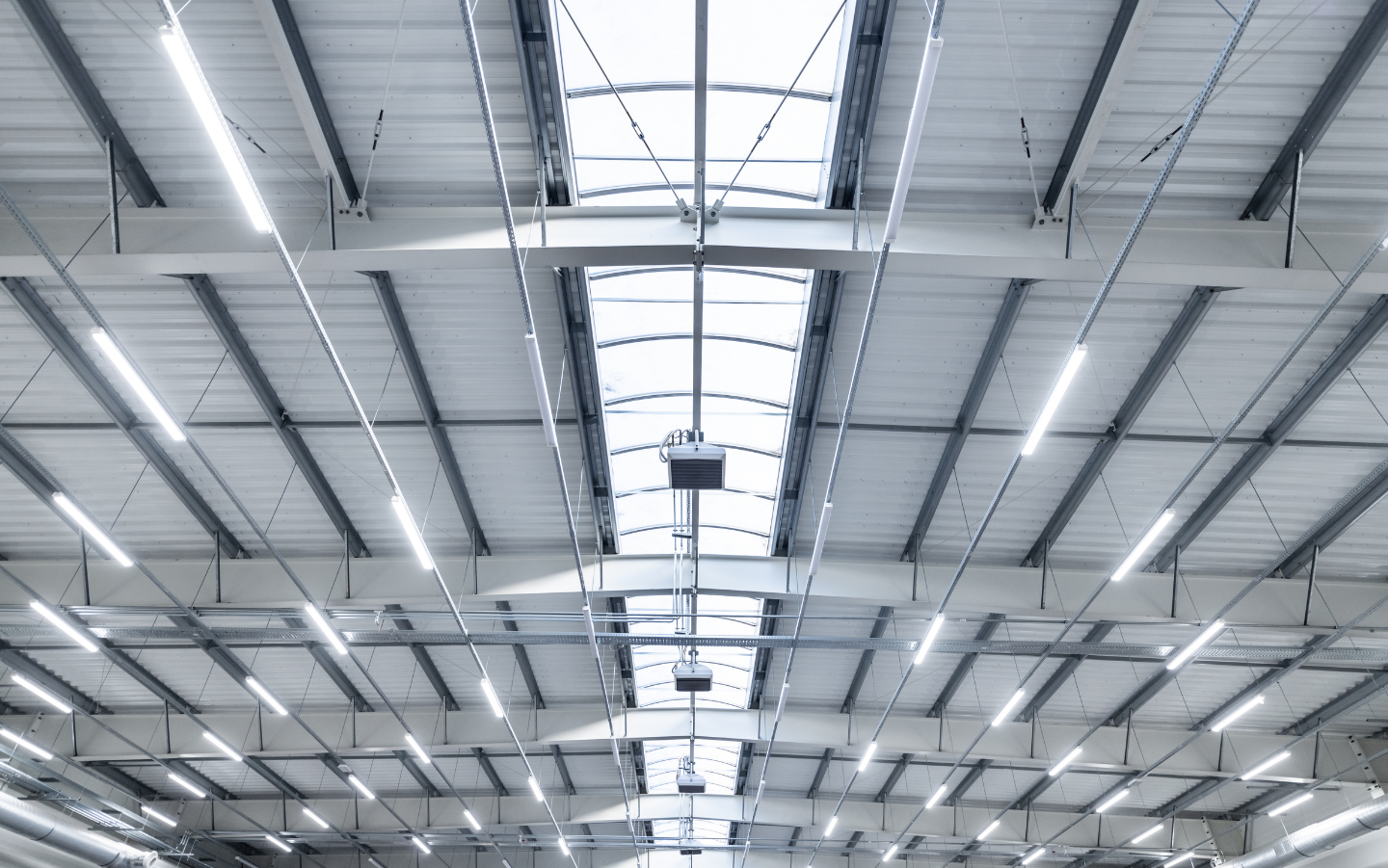
Poor lighting is one of the most underestimated hazards in the American workplace. It rarely makes headlines the way machine guarding failures or fall incidents do, yet inadequate illumination contributes to slips, trips, falls, struck-by incidents, eye strain, fatigue, and costly errors every single day. That is exactly why OSHA lighting standards exist, and why understanding them is essential for anyone responsible for a warehouse, manufacturing plant, construction site, or commercial facility.
The challenge for most safety managers is that OSHA lighting requirements are not located in one single, tidy regulation. Instead, they are spread across several parts of the Code of Federal Regulations, supplemented by industry consensus standards, and enforced through both specific rules and OSHA's General Duty Clause. This guide pulls all of it together. We will walk through the specific foot-candle minimums OSHA enforces, explain how the rules differ between construction and general industry, cover industrial lighting standards OSHA inspectors actually look for, and finish with practical steps and answers to the most common questions facility teams ask.
Why Workplace Lighting Is a Safety Issue, Not Just a Comfort Issue
Before getting into the regulations themselves, it helps to understand why OSHA treats illumination as a genuine safety hazard rather than a matter of employee preference.
Inadequate lighting directly impairs hazard recognition. A worker who cannot clearly see a wet patch on the floor, a pallet jutting into a walkway, or the edge of a loading dock is far more likely to be injured by it. The Bureau of Labor Statistics consistently ranks slips, trips, and falls among the leading causes of nonfatal workplace injuries, and poor visibility is a recurring contributing factor in incident investigations.
Lighting also affects how safely people operate equipment. Forklift operators, crane operators, and machine tenders all depend on adequate contrast and visibility to judge distances, read load charts, and spot pedestrians. Dim or unevenly lit areas create shadows and glare zones where pedestrians effectively disappear from an operator's view.
Finally, lighting influences human performance over time. Chronic eye strain, headaches, and fatigue from working under insufficient or flickering light degrade attention and reaction time, which raises the likelihood of every other type of incident in the facility. In short, illumination is foundational. Nearly every other safety control in a workplace assumes that people can actually see what they are doing.
Where OSHA Lighting Regulations Live in the CFR
OSHA lighting regulations are distributed across several standards, and which ones apply to you depends on the type of work being performed:
- 29 CFR 1926.56 (Construction) is the most explicit standard. It sets minimum illumination intensities, measured in foot-candles, for specific construction work areas. If you manage construction sites, this is your primary reference.
- 29 CFR 1910 (General Industry) does not contain a single comprehensive illumination table the way the construction standard does. Instead, lighting requirements appear within specific general industry standards, including exit routes (1910.37), hazardous waste operations (1910.120), powered industrial trucks (1910.178), and the electrical standards (1910.303 and 1910.305) governing how lighting fixtures themselves must be installed and maintained.
- 29 CFR 1915.82 (Shipyard Employment) sets illumination requirements for vessels, dry docks, and shipyard work areas.
- The General Duty Clause, Section 5(a)(1) of the OSH Act, is the catch-all. Even where no specific foot-candle number applies, employers must keep the workplace free of recognized hazards. OSHA has cited employers under the General Duty Clause for lighting conditions that created recognized hazards, often referencing consensus standards such as ANSI/IES recommended practices as evidence of what the industry recognizes as adequate.
Understanding this structure matters because many facility managers and safety professionals search for one universal OSHA brightness number and come away confused. The honest answer is that the number depends on the environment, the task, and the governing standard.
OSHA Lighting Requirements for Construction: 29 CFR 1926.56
The clearest and most frequently cited OSHA lighting requirements appear in the construction standard. Under 1926.56, construction areas, ramps, runways, corridors, offices, shops, and storage areas must be lighted to minimum illumination intensities while any work is in progress. The standard expresses these minimums in foot-candles, a unit equal to one lumen of light falling on one square foot of surface.
The key minimums in Table D-3 of the standard are:
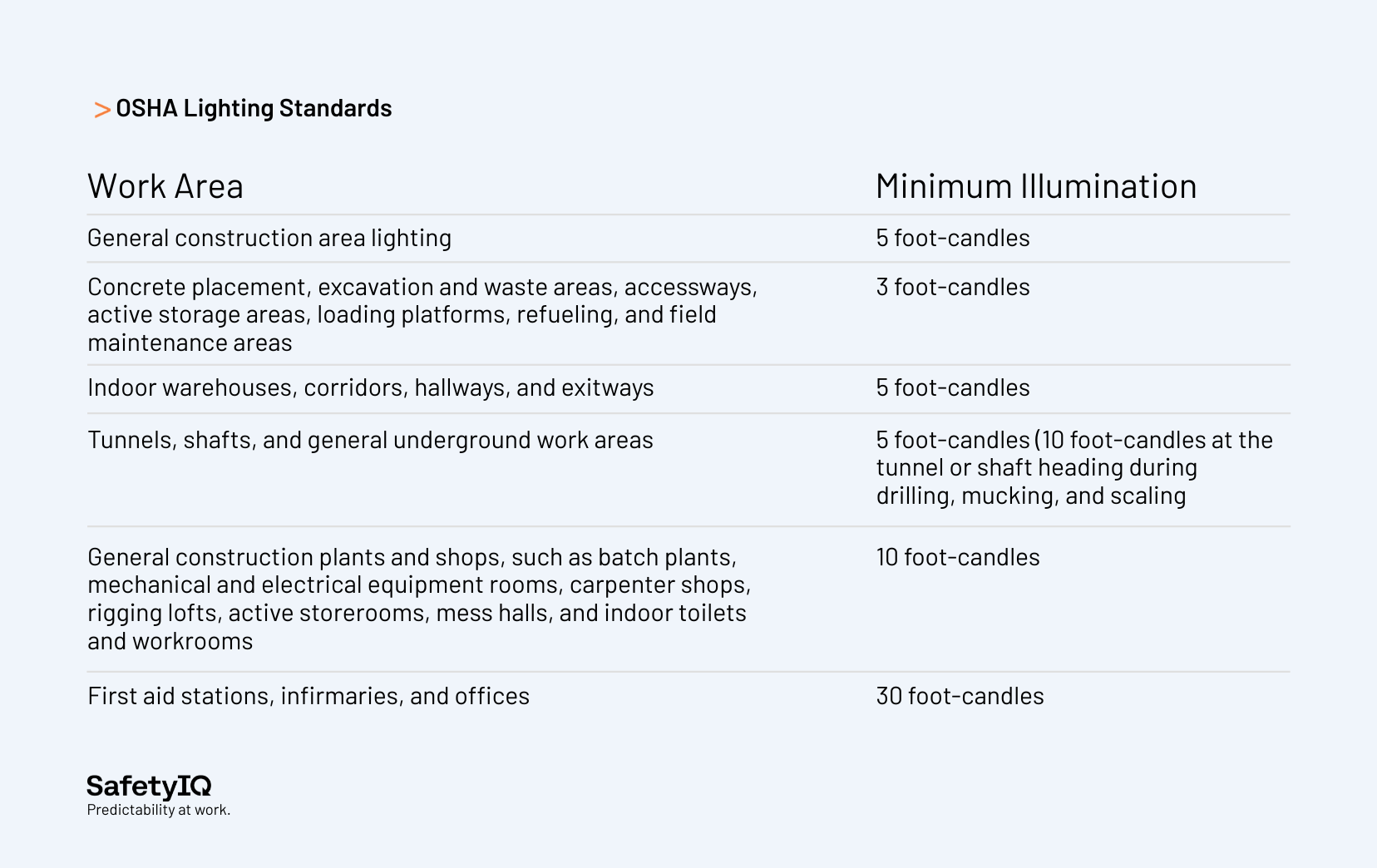
A few practical notes about applying this table.
First, these are minimums measured at the working surface, not aspirational targets. A contractor who provides exactly 5 foot-candles in a general work area is technically compliant but leaves no margin for burned-out lamps, dust accumulation on fixtures, or shadowed corners.
Second, the standard applies whenever work is in progress, which includes night shifts, early-morning starts, and interior work in buildings without finished electrical systems. Temporary lighting strings, portable light towers, and task lighting all count toward compliance as long as the measured illumination meets the minimums and the equipment itself complies with the electrical safety rules in Subpart K.
OSHA Lighting Requirements for General Industry
For factories, warehouses, distribution centers, and most permanent workplaces, OSHA lighting requirements are woven into several general industry standards rather than presented in one table.
Exit routes (29 CFR 1910.37). Every exit route must be adequately lighted so that an employee with normal vision can see along the route. Exit signs must be illuminated to a surface value of at least 5 foot-candles by a reliable light source, and self-luminous or electroluminescent signs must maintain a minimum luminance. This is one of the few places in the general industry rules where OSHA states a specific light level, and it is a frequent inspection item because it is easy to verify.
Powered industrial trucks (29 CFR 1910.178). Where general lighting is less than 2 lumens per square foot, OSHA requires auxiliary directional lighting on the truck itself. This rule matters enormously at loading docks and inside trailers, which are often the darkest spots in an otherwise well-lit warehouse. If your forklifts routinely enter dim trailers or poorly lit yard areas, truck-mounted lights are not optional.
Hazardous waste operations (29 CFR 1910.120). HAZWOPER sites have their own illumination table that closely mirrors the construction minimums, ranging from 3 foot-candles in excavation and waste areas up to 30 foot-candles in first aid stations and offices.
Electrical standards (29 CFR 1910.303 and 1910.305). These rules govern the fixtures themselves: listing and labeling by a nationally recognized testing laboratory, proper installation, guarding of lamps subject to breakage, suitability for wet or hazardous locations, and safe wiring of temporary lighting. A facility can have plenty of light and still be cited if the fixtures are damaged, improperly wired, or unsuitable for the environment.
The General Duty Clause. For ordinary production floors and work areas without a named foot-candle minimum, OSHA relies on the General Duty Clause combined with recognized industry guidance. If lighting is so poor that it creates a recognized hazard, such as an unlit stairwell or a press operation performed in deep shadow, OSHA can and does cite it.
Industrial Lighting Standards OSHA Inspectors Reference: ANSI and IES
When compliance officers and safety professionals evaluate whether lighting in a general industry setting is adequate, the benchmark most often used alongside the regulations is the body of recommended practices published by the Illuminating Engineering Society, particularly ANSI/IES RP-7, the recommended practice for lighting industrial facilities.
These industrial lighting standards OSHA inspectors and consultants lean on are task-based rather than area-based. Instead of one number for an entire building, they recommend illumination levels matched to the visual difficulty of the work. Representative recommendations include roughly 10 to 30 foot-candles for simple material handling and rough warehousing, 30 to 50 foot-candles for general assembly and machining, 50 to 100 foot-candles for fine assembly and detailed inspection work, and 100 foot-candles or more for very fine bench work, quality control, and precision tasks.
Two points are worth emphasizing.
First, IES recommendations are consensus guidance, not law, but they carry real weight. OSHA has referenced consensus standards in General Duty Clause citations as evidence that a hazard was recognized by the industry.
Second, designing to IES levels rather than bare OSHA minimums is simply good business. Studies of industrial facilities repeatedly link improved lighting to fewer errors, lower scrap rates, and reduced incident frequency, which means lighting upgrades frequently pay for themselves independent of compliance.
Following published osha lighting guidelines and IES recommended practices together gives you a defensible, layered position: the regulatory minimums establish your floor, and the consensus standards establish what a reasonably prudent employer in your industry provides.
Emergency and Exit Lighting Requirements
Normal illumination is only half the picture. OSHA lighting regulations also address what happens when the power goes out.
Exit routes must remain usable during an emergency, which means emergency illumination must be adequate for employees to find and travel the route. Most facilities meet this through battery-backed emergency lighting units, generator-fed egress circuits, or photoluminescent path marking used in combination with powered sources. The Life Safety Code, NFPA 101, which many jurisdictions adopt and which OSHA's exit route standard is harmonized with, calls for emergency illumination to last at least 90 minutes, with an initial average of one foot-candle along the path of egress.
Exit signs deserve special attention because they are among the most commonly cited items in routine inspections. Signs must be illuminated, legible, distinctive in color, and never obscured by decorations, stacked product, or equipment. Monthly functional testing and annual full-duration testing of battery units is the widely accepted maintenance practice, and documented test records are your best evidence of compliance.
How to Measure and Verify Compliance in Your Facility
Knowing the numbers is only useful if you can verify them. Here is a practical process for auditing your facility against OSHA lighting standards.
Step 1: Map your work areas by task. Walk the facility and categorize every space: general circulation, storage, loading docks, production lines, inspection stations, offices, stairwells, exit routes, and exterior areas. Each category carries a different requirement or recommendation, so a single facility-wide measurement is meaningless.
Step 2: Measure with a calibrated light meter. A quality digital lux meter or foot-candle meter costs little compared to a single citation. Take readings at the actual working plane, which is typically 30 inches above the floor for benches and desks, and at floor level for walkways and egress paths. Measure at multiple points in each area, including the dimmest spots between fixtures, not just directly beneath them. Remember the conversion if your meter reads in lux: one foot-candle equals approximately 10.76 lux.
Step 3: Measure under realistic conditions. Audit at night or with daylight contributions minimized if your facility runs second and third shifts. A warehouse that passes at noon with skylights blazing can fail badly at 2 a.m. Also measure with racking fully loaded, since stored product creates shadows that empty-aisle measurements miss.
Step 4: Document everything. Record the date, locations, meter model, calibration status, and readings. This documentation demonstrates good faith, helps you trend fixture degradation over time, and gives you a baseline for evaluating upgrade proposals.
Step 5: Correct deficiencies systematically. Burned-out lamps and dirty lenses are the cheapest fixes and often recover 20 to 30 percent of lost light. Beyond maintenance, consider fixture spacing, mounting height, color temperature, and glare control. Modern LED high-bay fixtures typically deliver more uniform illumination at lower energy cost than the metal halide and fluorescent systems they replace.
Common Lighting Violations and What They Cost
Certain lighting-related failures show up again and again in OSHA citation data and inspection reports:
- Inadequate illumination in active construction areas, particularly during night work, interior finishing before permanent power, and excavation work, cited directly under 1926.56.
- Obscured, unlit, or missing exit signs and inadequately lighted exit routes, cited under 1910.37, and frequently discovered during inspections triggered by unrelated complaints.
- Damaged or improperly installed light fixtures, including missing lamp guards in areas where breakage is likely, unlisted fixtures, exposed wiring on temporary light strings, and fixtures unsuitable for wet or classified locations, cited under the electrical standards.
- Failure to provide auxiliary forklift lighting in dim trailers, rail cars, and yard areas where ambient light falls below 2 lumens per square foot.
- Nonfunctional emergency lighting revealed by a simple test-button press during a walkthrough.
Penalties are not trivial. As of recent annual adjustments, serious violations can run into five figures per item, and willful or repeat violations can exceed $160,000 each. More importantly, a lighting citation almost always accompanies an injury investigation, which means the real cost includes workers' compensation, lost time, and litigation exposure far beyond the penalty itself.
Practical OSHA Lighting Guidelines for Staying Compliant
Pulling everything together, here is a concise set of osha lighting guidelines that keep most facilities on the right side of an inspection:
- Know which standard governs each space. Construction activity follows 1926.56, general industry spaces follow the applicable 1910 provisions, and everything is backstopped by the General Duty Clause.
- Design to IES recommended levels, not bare minimums. Regulatory minimums are a floor. Task-appropriate illumination is what actually prevents incidents.
- Audit with a meter at least annually, after any lighting retrofit, and whenever shifts, layouts, or racking change.
- Build lighting into preventive maintenance. Group relamping, lens cleaning, and emergency-unit testing should appear on a schedule with sign-offs, not happen ad hoc when someone complains.
- Pay special attention to transition zones. Dock doors, building entrances, trailer interiors, stairwells, and mezzanines are where illumination drops sharply and where incidents cluster.
- Use listed equipment appropriate to the environment. Wet locations, washdown areas, freezers, and hazardous classified locations each demand fixtures rated for those conditions.
- Train employees to report lighting deficiencies the same way they would report a damaged guard or a leaking pipe, and close those reports quickly.
The Bottom Line
OSHA lighting standards are less about any single magic number and more about a layered obligation: meet the explicit foot-candle minimums where they exist, follow the equipment and egress rules everywhere, and provide illumination genuinely adequate for the task under the General Duty Clause. Employers who treat lighting as a managed safety system, with defined levels, scheduled maintenance, and documented measurements, rarely have trouble with inspectors and, far more importantly, rarely have employees hurt because they simply could not see the hazard in front of them.
OSHA Lighting Standards: Frequently Asked Questions
What is the minimum lighting required by OSHA?
There is no single minimum that applies to every workplace, because OSHA sets illumination levels by environment and activity. For construction work, 29 CFR 1926.56 establishes the most explicit minimums: 3 foot-candles for excavation, waste areas, accessways, and loading platforms; 5 foot-candles for general construction areas, indoor warehouses, corridors, and exitways; 10 foot-candles for construction shops and plants; and 30 foot-candles for first aid stations, infirmaries, and offices. In general industry, specific minimums appear in individual standards, such as the 5 foot-candle illumination requirement for exit signs. Where no explicit number exists, OSHA expects lighting adequate for the task under the General Duty Clause, and inspectors commonly reference ANSI/IES recommended practice levels as the benchmark for what adequate means in an industrial setting.
What are OSHA requirements for lighting in a warehouse or factory?
General industry facilities are governed by several overlapping provisions rather than one table. Exit routes must be adequately lighted and exit signs illuminated to at least 5 foot-candles. Light fixtures must be listed by a recognized testing laboratory, properly installed, guarded where lamps are subject to breakage, and rated for the environment they are in, such as wet or hazardous locations. Forklifts must carry auxiliary directional lighting wherever general illumination falls below 2 lumens per square foot, which commonly applies inside trailers and at dock doors. Emergency lighting must allow safe egress during a power failure. Beyond those specific rules, employers must provide illumination sufficient to keep the workplace free of recognized hazards, and most safety professionals use IES recommended levels, roughly 10 to 30 foot-candles for warehousing and 30 to 50 or more for assembly and inspection work, as the working target.
Are dock lights required by OSHA?
OSHA does not have a standard that names dock lights as a specific required device, but several rules effectively make supplemental dock lighting necessary in many operations. The powered industrial truck standard requires auxiliary lighting on forklifts when general illumination is below 2 lumens per square foot, and the interior of a trailer or railcar is almost always below that threshold. Loading platforms on construction sites carry a 3 foot-candle minimum under 1926.56. In general industry, an unlit trailer interior where employees walk, lift, and operate equipment can be cited as a recognized hazard under the General Duty Clause. In practice, the combination of trailer-entry forklift work and pedestrian loading activity means most facilities need either truck-mounted lights, articulating dock lights at each door, or both to operate safely and defensibly.
Are LED disk lights OSHA approved?
OSHA does not approve, certify, or endorse specific lighting products of any kind, so no fixture, LED or otherwise, can accurately be marketed as OSHA approved. What OSHA requires is that electrical equipment, including LED disk lights and retrofit kits, be listed and labeled by a Nationally Recognized Testing Laboratory such as UL, ETL, or CSA, and that it be installed and used in accordance with that listing and the electrical standards in 29 CFR 1910 Subpart S or 1926 Subpart K. An NRTL-listed LED disk light installed per its labeling is fully acceptable, and LEDs are generally an upgrade for compliance purposes because they deliver more uniform light, resist breakage better than glass lamps, and degrade more slowly. The compliance question is never the technology; it is the listing, the installation, the suitability for the location, and whether the resulting illumination meets the required levels.
Is light duty an OSHA recordable?
This question uses light in a different sense, but it comes up constantly in safety departments. Under OSHA's recordkeeping rule, 29 CFR 1904, a work-related injury or illness is recordable if it results in medical treatment beyond first aid, days away from work, loss of consciousness, death, or restricted work or job transfer. Light duty falls into that last category. If a physician or the employer restricts an employee from performing one or more routine functions of their job, or from working a full shift, the case must be recorded on the OSHA 300 log as a restricted work case, with the days of restriction counted. The common misconception is that keeping an injured employee working on light duty avoids recordability; it does not. It can, however, legitimately prevent the case from being a more serious days-away entry, which is one reason well-run return-to-work programs still benefit both the employee and the employer's injury statistics.
SafetyIQ brings incidents, inspections, training, journey management, lone worker safety and fatigue into one mobile app. Tell us about your crews and sites for tailored pricing.
Safety insights, straight to your inbox
New guides, monthly safety topics and SafetyIQ updates for EHS and operations leaders. Unsubscribe anytime.

Get a demo built around your sites, your teams, and the way your people work.
EHS, journey, and fatigue management software for field-heavy teams.

.png)

.png)