
The 7 Principles of HACCP for Maintaining Food Safety Standards
Discover the key elements of Hazard Analysis and Critical Control Points (HACCP) and how it ensures food safety. Learn the seven principles and more.
Food safety is not a matter of luck. Behind every safe meal served in a restaurant, every packaged product on a grocery shelf, and every ingredient shipped between facilities lies a systematic approach designed to prevent harm before it ever reaches a consumer. That approach, in much of the modern food industry, is HACCP. Standing for Hazard Analysis and Critical Control Points, HACCP is a preventive food safety management system recognized and required across the globe. This guide explains what HACCP is, where it came from, how it works, and why it has become the backbone of food safety programs worldwide.
What Is HACCP?
HACCP is a structured, science-based system that identifies specific hazards in food production and establishes measures to control them. Rather than relying on inspecting finished products to catch problems after the fact, HACCP focuses on preventing hazards throughout the production process. This proactive philosophy is what sets it apart from older quality-control models that depended heavily on end-product testing.
The system addresses three broad categories of hazards. Biological hazards include bacteria, viruses, and parasites such as Salmonella, Listeria, and E. coli. Chemical hazards encompass cleaning agents, pesticide residues, allergens, and naturally occurring toxins. Physical hazards refer to foreign objects like glass, metal fragments, or plastic that could injure a consumer. By analyzing where these hazards might enter the food supply, businesses can build controls at the exact points where intervention matters most.
The Origins of HACCP
HACCP did not begin in a restaurant kitchen. It was developed in the 1960s through a collaboration between the Pillsbury Company, NASA, and the U.S. Army Natick Laboratories. The goal was to produce food that astronauts could eat in space with near-zero risk of foodborne illness. Traditional testing methods would have required destroying so much product to verify safety that little would remain to actually send into orbit. A preventive system was needed instead, one that built safety into every stage of production.
The concept proved so effective that it gradually spread beyond the space program into the broader food industry. Over the following decades, regulatory bodies and international organizations adopted and refined the principles, transforming HACCP from a niche aerospace solution into a global standard.
Why HACCP Matters Today
The relevance of HACCP has only grown as food supply chains have become longer and more complex. A single product may contain ingredients sourced from multiple countries, processed in several facilities, and transported across thousands of miles before reaching a plate. Each step introduces opportunities for contamination. HACCP provides a common framework that any link in this chain can apply, creating consistency and accountability from farm to fork.
Beyond protecting public health, HACCP offers tangible business benefits. It reduces the likelihood of costly recalls, protects brand reputation, and often serves as a prerequisite for entering certain markets or securing contracts with major buyers. In many jurisdictions, it is not merely recommended but legally mandated.
The Seven Principles of HACCP
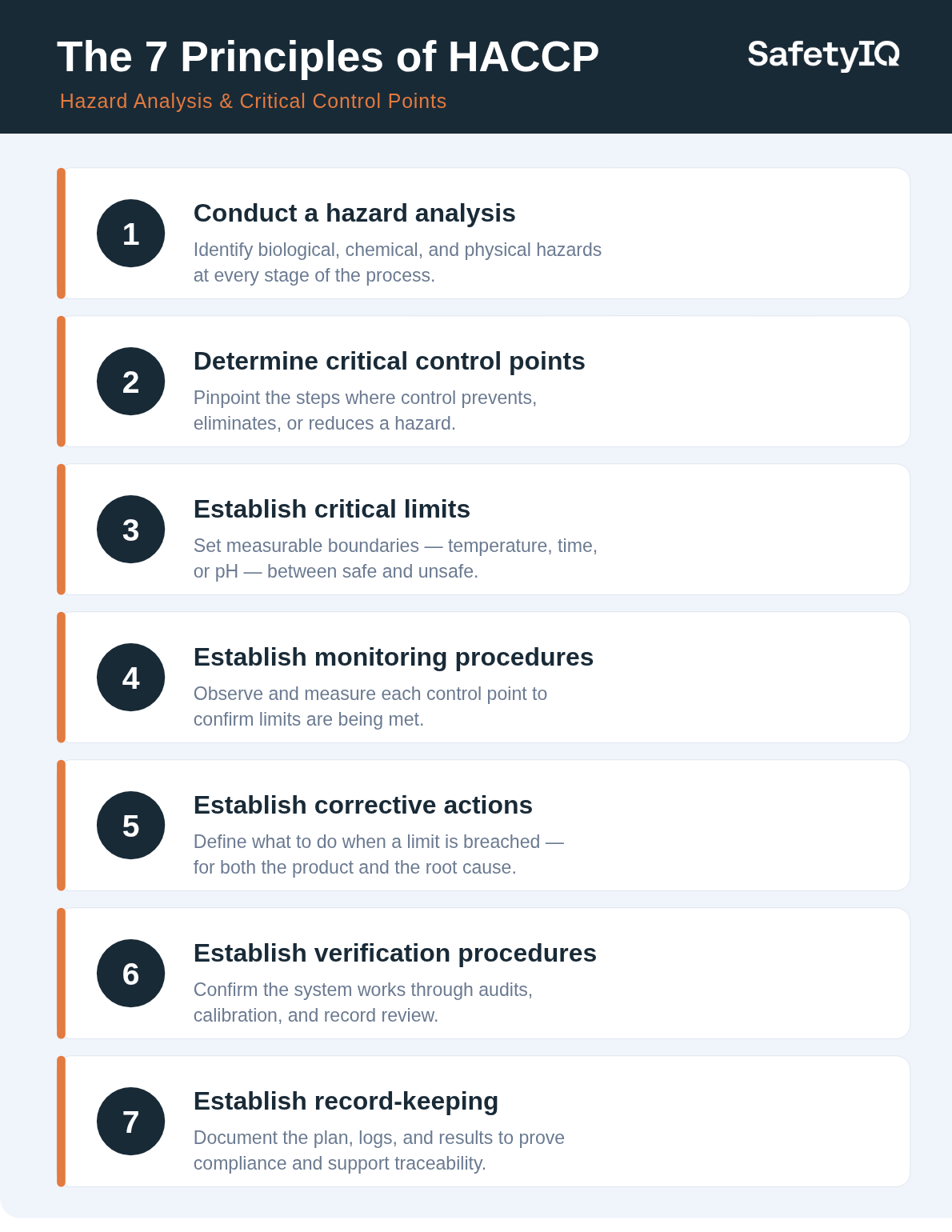
At the heart of every HACCP system are seven core principles. These principles form a logical sequence, each building on the one before it. Understanding them is essential to grasping how the entire system functions.
Principle 1: Conduct a Hazard Analysis
The first step is to examine every stage of the food production process and identify potential hazards. This involves looking at raw materials, processing methods, storage conditions, and handling practices. For each identified hazard, the team assesses its likelihood and severity, then determines what preventive measures could control it. This analysis forms the foundation upon which the rest of the plan is constructed.
Principle 2: Determine the Critical Control Points
A Critical Control Point, or CCP, is a step in the process where control can be applied to prevent, eliminate, or reduce a hazard to an acceptable level. Not every step is a CCP. Cooking, chilling, and metal detection are common examples because failure at these points could directly result in unsafe food. Identifying CCPs accurately is crucial, as overestimating them wastes resources while missing them leaves dangerous gaps.
Principle 3: Establish Critical Limits
For each CCP, a critical limit defines the boundary between safe and unsafe. These limits are usually measurable values such as a minimum cooking temperature, a maximum time at a certain temperature, or a specific pH level. For instance, cooking poultry to an internal temperature that destroys harmful bacteria establishes a clear, scientifically supported critical limit.
Principle 4: Establish Monitoring Procedures
Monitoring involves observing or measuring the CCPs to confirm they remain within their critical limits. This might mean checking temperatures at regular intervals, recording times, or testing samples. Effective monitoring requires clear procedures specifying what is measured, how, how often, and who is responsible. Consistent monitoring ensures that deviations are caught quickly.
Principle 5: Establish Corrective Actions
When monitoring reveals that a critical limit has been breached, predetermined corrective actions must be taken. These actions address both the immediate problem, such as what to do with the affected product, and the underlying cause to prevent recurrence. Having these responses planned in advance means staff can react decisively rather than improvising during a crisis.
Principle 6: Establish Verification Procedures
Verification confirms that the HACCP system is working as intended. This goes beyond routine monitoring and includes activities like reviewing records, calibrating equipment, conducting audits, and occasionally testing products. Verification provides confidence that the plan is not just being followed on paper but is genuinely effective in practice.
Principle 7: Establish Record-Keeping and Documentation
The final principle requires maintaining thorough records of the entire HACCP system. Documentation includes the hazard analysis, CCP determinations, monitoring logs, corrective actions, and verification results. These records demonstrate compliance, support traceability, and prove invaluable during inspections or investigations.
Implementing a HACCP Plan
Knowing the seven principles is one thing; putting them into practice is another. Successful implementation follows a series of preliminary steps before the principles are even applied.
Building the HACCP Team
A HACCP plan should never be developed by a single person. It requires a multidisciplinary team with knowledge spanning production, quality assurance, microbiology, engineering, and sanitation. This diversity ensures that hazards are viewed from multiple angles and that the resulting plan is both practical and comprehensive. Smaller businesses may bring in outside expertise to supplement their internal knowledge.
Describing the Product and Its Use
Before analyzing hazards, the team must thoroughly describe the product, including its ingredients, processing methods, packaging, and shelf life. They must also identify the intended consumer. A product meant for vulnerable populations such as infants, the elderly, or immunocompromised individuals demands stricter controls than one aimed at the general public.
Constructing and Verifying the Flow Diagram
A flow diagram maps every step of the production process from receiving raw materials to dispatching the finished product. This visual tool helps the team see the entire operation clearly and pinpoint where hazards might arise. Importantly, the diagram must be verified against the actual process on the production floor, since written procedures sometimes differ from real-world practice.
Prerequisite Programs
HACCP does not operate in isolation. It rests on a foundation of prerequisite programs, which are the basic conditions and activities necessary to maintain a hygienic environment. These include good manufacturing practices, sanitation procedures, pest control, employee training, and supplier management. Without solid prerequisite programs in place, even a well-designed HACCP plan will struggle to function effectively.
HACCP and Regulatory Requirements
Across the world, HACCP has been woven into food safety law. In the United States, it is mandatory for seafood, juice, and meat and poultry processing, and its principles underpin the broader Food Safety Modernization Act. In the European Union, food business operators are generally required to implement procedures based on HACCP principles. The Codex Alimentarius, established by the Food and Agriculture Organization and the World Health Organization, provides internationally recognized HACCP guidelines that many countries use as a reference.
Certification and Standards
While HACCP itself is a system, various certification schemes incorporate it as a core component. Standards such as those recognized by the Global Food Safety Initiative often require a functioning HACCP plan as part of certification. Achieving such certification can open doors to international markets and reassure customers that a business meets rigorous safety expectations.
Common Challenges and How to Overcome Them
Implementing HACCP is rarely without obstacles. One frequent challenge is resistance to change, particularly in established operations where staff are accustomed to existing routines. Clear communication about the benefits, combined with thorough training, helps overcome this hesitation.
Another challenge lies in correctly identifying CCPs. Teams sometimes designate too many control points, diluting focus and overburdening staff, or too few, leaving genuine hazards uncontrolled. Using decision tools and drawing on expert input improves accuracy. Maintaining documentation can also feel burdensome, but digital record-keeping systems, like EHS management software, have made this far more manageable, reducing errors and saving time.
Finally, a HACCP plan is not a one-time project. It must be reviewed and updated whenever processes, ingredients, equipment, or regulations change. Treating it as a living system rather than a static document is key to long-term success.
HACCP represents a fundamental shift in how the world approaches food safety, moving from reaction to prevention. Born from the demanding requirements of space travel, it has matured into a universal language of safety understood across borders and industries. By systematically identifying hazards and controlling them at the points that matter most, HACCP protects consumers, supports businesses, and strengthens trust in the food we eat every day. For any organization involved in producing, processing, or handling food, understanding and applying HACCP is not just good practice; it is an essential commitment to safety.
HACCP and Food Safety: Frequently Asked Questions
What is the difference between HACCP and a food safety management system?
HACCP and a food safety management system are related but not identical concepts, and the distinction often causes confusion. HACCP is a specific, focused methodology built around identifying and controlling hazards at critical points in the production process using its seven established principles. It is, in essence, a tool designed to manage food safety risks. A food safety management system, on the other hand, is a much broader framework that encompasses HACCP as one of its components. A complete food safety management system includes prerequisite programs such as sanitation and good manufacturing practices, management commitment, communication procedures, continuous improvement processes, and often elements addressing quality, traceability, and emergency response. Standards like ISO 22000, for example, integrate HACCP principles within a wider management structure that also addresses organizational responsibilities and system maintenance. In practical terms, you can think of HACCP as the engine focused specifically on hazard control, while the food safety management system is the entire vehicle that houses that engine along with everything else needed to operate safely and consistently. A business may have a HACCP plan, but to be fully effective, that plan needs to sit within a supportive management system that ensures it is properly resourced, monitored, and improved over time.
Do small businesses and restaurants need to implement HACCP?
Whether a small business or restaurant must formally implement HACCP depends largely on the jurisdiction and the nature of the operation, but the underlying principles are valuable for any food business regardless of size. In many regions, full HACCP plans are legally required only for certain higher-risk sectors such as meat processing, seafood, and juice production. However, regulations increasingly expect food establishments of all sizes to apply HACCP-based principles even if a full documented plan is not mandated. Many countries offer simplified or scaled approaches designed specifically for smaller operations, sometimes called HACCP-based or HACCP-lite systems, which capture the essential preventive logic without the extensive documentation burden of a large processing facility. For a small restaurant, this might mean focusing on key control points such as cooking temperatures, cold storage, cross-contamination prevention, and proper handwashing rather than producing volumes of paperwork. The practical reality is that even when not strictly required, adopting HACCP thinking helps small businesses prevent foodborne illness, reduce waste, demonstrate due diligence to inspectors, and protect their reputation. Given that a single foodborne illness outbreak can devastate a small establishment financially and reputationally, the investment in HACCP-based practices is generally well worth the effort regardless of legal obligation.
How often should a HACCP plan be reviewed and updated?
A HACCP plan should never be treated as a document you create once and file away permanently. It is a living system that requires regular review to remain effective and accurate. As a general rule, most food safety experts recommend conducting a formal review of the entire HACCP plan at least once a year, even if no obvious changes have occurred, simply to confirm that everything remains valid and that the documented procedures still reflect actual practice. Beyond this scheduled annual review, the plan must be reassessed immediately whenever a significant change takes place in the operation. Such triggers include introducing a new product or recipe, changing an ingredient or supplier, modifying a production process, installing new equipment, altering packaging, or discovering a previously unrecognized hazard. Changes in regulations or new scientific findings about hazards also necessitate a review. Additionally, if monitoring repeatedly reveals deviations at a particular control point, or if a food safety incident occurs, this signals that the plan may need revision. The verification activities built into the HACCP system itself, such as record review and auditing, often surface the need for updates. Keeping the plan current ensures that it continues to address real risks rather than outdated assumptions, and it demonstrates to regulators and customers that the business takes ongoing food safety seriously.
What qualifications or training are needed to develop a HACCP plan?
Developing an effective HACCP plan requires a combination of food safety knowledge, process understanding, and familiarity with the HACCP methodology itself, which is why it is typically a team effort rather than the responsibility of a single individual. While there is no single universal qualification required everywhere, recognized HACCP training courses are widely available and often expected. These courses range from introductory awareness training for general staff to advanced certified programs for those who will lead plan development. Many accredited training providers offer courses based on Codex Alimentarius principles, and some certification schemes specify the level of training required for the HACCP team leader. The team leader ideally should have completed a formal, accredited HACCP course and possess a solid grasp of food microbiology, hazard identification, and the production processes involved. Other team members contribute specialized knowledge from areas such as engineering, quality assurance, sanitation, and operations, and they benefit from at least foundational HACCP training so they understand the framework. For small businesses lacking in-house expertise, hiring a qualified consultant or sending a key staff member to a recognized certification course is a common and sensible approach. Ultimately, the goal is to ensure that those responsible understand not just the mechanics of the seven principles but also the scientific reasoning behind hazard control, enabling them to make sound judgments tailored to their specific operation.
Can HACCP guarantee that food is completely safe?
This is an important question that touches on a common misconception about what HACCP can and cannot achieve. HACCP is one of the most powerful tools available for managing food safety, but it cannot provide an absolute, one hundred percent guarantee that food is completely free from all risk. What HACCP does is dramatically reduce the likelihood of hazards reaching the consumer by systematically identifying risks and controlling them at the points where control is most effective. It shifts the odds heavily in favor of safety, but food production involves biological systems, human beings, and complex supply chains, all of which introduce inherent variability that no system can entirely eliminate. The effectiveness of HACCP depends entirely on how well it is designed, implemented, monitored, and maintained. A poorly constructed plan, inadequate staff training, lax monitoring, or failure to update the plan when conditions change can all create vulnerabilities. Furthermore, HACCP relies on robust prerequisite programs such as proper sanitation and hygiene; if these foundations are weak, the HACCP plan cannot compensate. It is also worth noting that HACCP addresses identified and reasonably foreseeable hazards, but entirely novel or unexpected threats may not be captured until they are recognized. For these reasons, HACCP should be understood as a system that makes food as safe as reasonably achievable through diligent, science-based prevention, rather than a magic shield that removes all possibility of harm. When implemented with genuine commitment and supported by a strong overall food safety culture, it is exceptionally effective, which is precisely why it has become the global standard.
SafetyIQ brings incidents, inspections, training, journey management, lone worker safety and fatigue into one mobile app. Tell us about your crews and sites for tailored pricing.
Safety insights, straight to your inbox
New guides, monthly safety topics and SafetyIQ updates for EHS and operations leaders. Unsubscribe anytime.



Get a demo built around your sites, your teams, and the way your people work.
EHS, journey, and fatigue management software for field-heavy teams.

.png)

.png)