
SPCC Meaning and How to Build a Spill Prevention Plan
Learn the meaning of Spill Prevention, Control, and Countermeasure (SPCC) and how to build a compliant plan to keep oil out of navigable waters.
Oil spills conjure images of tanker disasters and offshore blowouts, but the reality is that many spills begin much closer to home, at ordinary facilities storing oil for everyday operations. A leaking tank, an overfilled drum, or a ruptured pipe can send oil into nearby streams, rivers, and groundwater with serious environmental and legal consequences. To prevent these incidents before they happen, the United States Environmental Protection Agency established the Spill Prevention, Control, and Countermeasure rule, commonly known as SPCC. This guide explains what SPCC is, who must comply, what a plan involves, and why it matters for any organization that stores oil.
What Is Spill Prevention, Control, and Countermeasure?
The Spill Prevention, Control, and Countermeasure rule is a federal regulation designed to prevent oil from reaching navigable waters of the United States and adjoining shorelines. Rather than focusing on cleanup after a spill, SPCC is fundamentally preventive. It requires facilities to plan ahead, build safeguards into their operations, and prepare to respond quickly should a discharge occur.
SPCC falls under the broader framework of the Clean Water Act, which aims to protect the nation's water resources from pollution. The rule is part of the Oil Pollution Prevention regulation found in Title 40 of the Code of Federal Regulations, Part 112. Its core philosophy mirrors other strong safety systems: it is far better, cheaper, and safer to prevent a problem than to manage its aftermath.
The Purpose Behind the Rule
The central goal of SPCC is to keep oil out of waterways. Even relatively small discharges can cause significant harm, contaminating drinking water sources, killing aquatic life, and damaging ecosystems that take years to recover. By requiring facilities to anticipate where spills might occur and to install appropriate containment, the rule reduces both the likelihood and the impact of oil discharges.
Beyond environmental protection, SPCC also serves to assign responsibility. It makes clear that the owners and operators of facilities storing oil bear the duty of preventing spills, rather than leaving the burden of cleanup to the public or downstream communities.
What Counts as Oil
One common misconception is that SPCC applies only to petroleum. In fact, the rule covers a broad range of oil types. This includes petroleum and fuel oils, but it also encompasses animal fats, vegetable oils, synthetic oils, and other non-petroleum oils. A food processing plant storing large quantities of cooking oil can be just as subject to SPCC as a fuel depot. Understanding this broad definition is essential to determining whether a facility falls under the rule.
Who Must Comply with SPCC?
Not every business that keeps a can of motor oil in a closet needs an SPCC plan. The rule applies to facilities that meet specific criteria related to oil storage capacity and the potential to discharge oil into water.
Threshold Requirements
A facility is generally subject to SPCC if it has an aggregate aboveground oil storage capacity greater than 1,320 gallons, or a completely buried storage capacity greater than 42,000 gallons. Importantly, the threshold is based on storage capacity, not on the amount of oil actually present at a given moment. Only containers with a capacity of 55 gallons or more count toward the aboveground total.
In addition to the capacity threshold, there must be a reasonable expectation that a discharge could reach navigable waters or adjoining shorelines. This determination considers the facility's location, drainage patterns, and the absence of permanent containment structures.
Types of Facilities Affected
A wide variety of operations fall under SPCC. These include manufacturing plants, farms, oil production and storage facilities, electric utilities, warehouses, and many others. Industries that might not immediately associate themselves with oil, such as food producers or municipalities operating fleet maintenance yards, frequently discover they are subject to the rule. The common thread is the storage of oil in quantities that could pose a risk to water resources.
Components of an SPCC Plan
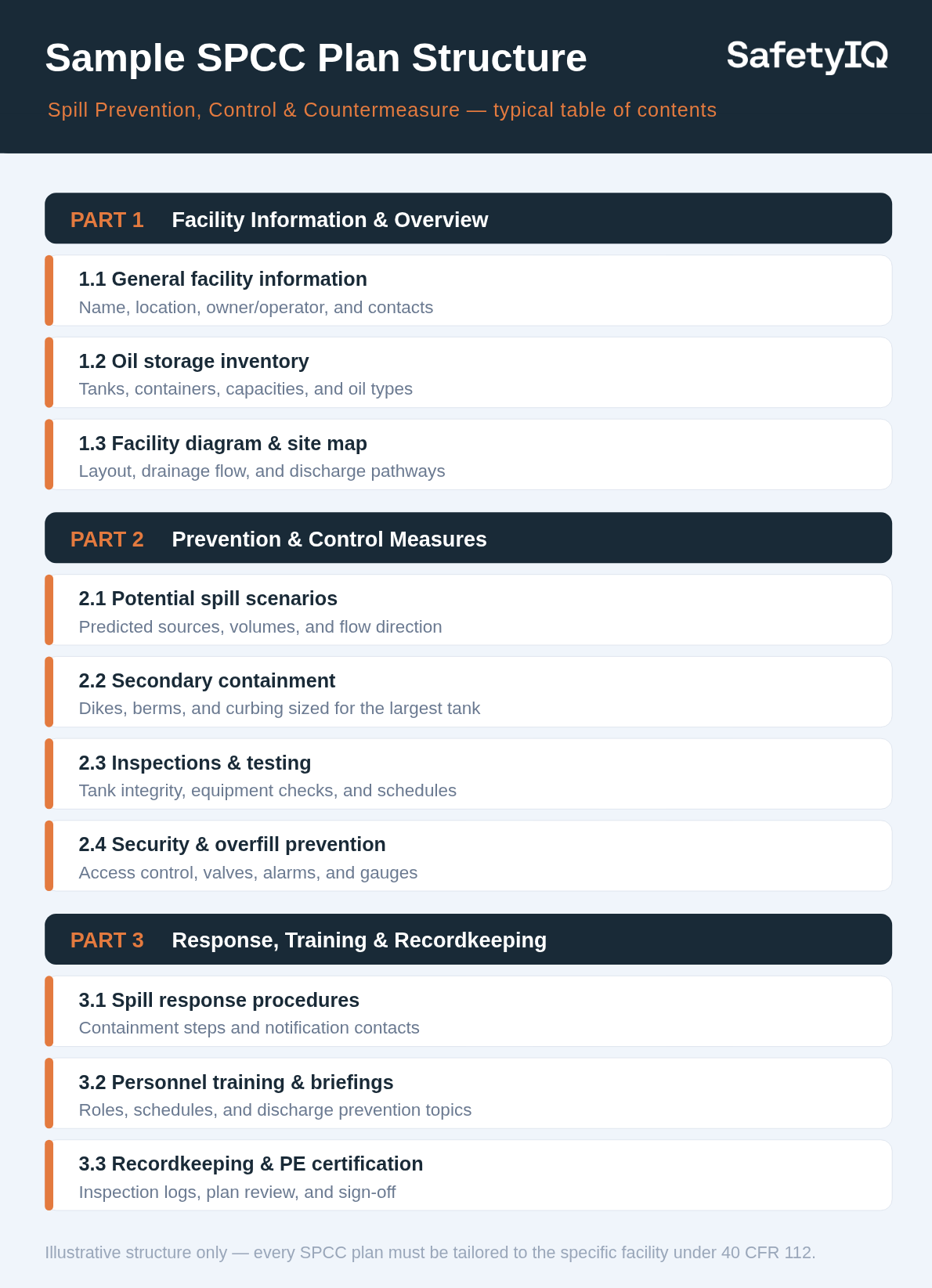
At the heart of compliance is the SPCC plan itself, a detailed document describing how a facility will prevent, control, and respond to oil discharges. The plan must be tailored to the specific facility rather than copied from a generic template, reflecting the actual conditions and risks present.
Prevention Measures
Prevention is the first line of defense. The plan must describe the physical and operational measures in place to stop spills from occurring. This includes proper tank design and integrity, overfill prevention systems, regular inspections, and employee training. By identifying potential failure points and addressing them proactively, facilities reduce the chance of a discharge ever happening.
Control and Containment
Even with strong prevention, spills can still occur, so the plan must address how oil will be contained. Secondary containment is a cornerstone of SPCC. This typically means structures such as dikes, berms, or curbing capable of holding the contents of the largest container plus an allowance for precipitation. The aim is to ensure that if a tank fails or overflows, the oil is captured rather than allowed to spread toward waterways.
Countermeasures and Response
The final element addresses what happens when a spill does occur despite all precautions. The plan outlines the steps personnel will take to respond, including how to stop the source, contain the discharge, and notify the appropriate authorities. Having clear, predetermined response procedures means staff can act decisively in a crisis rather than improvising under pressure.
Developing and Certifying the SPCC Plan
Creating an SPCC plan is not merely a paperwork exercise. The rule sets out specific requirements for how plans are prepared and certified, with the level of rigor depending on the size and complexity of the facility.
Professional Engineer Certification
For most facilities, the SPCC plan must be reviewed and certified by a licensed Professional Engineer. The engineer attests that the plan has been prepared in accordance with good engineering practice, that it addresses applicable requirements, and that procedures for inspections and testing have been established. This certification adds a layer of technical credibility and accountability.
Self-Certification for Qualified Facilities
Recognizing that smaller operations may not need the same level of oversight, the rule allows certain qualified facilities to self-certify their plans. A facility may qualify if it stays below a defined aggregate aboveground storage capacity and has a clean spill history. This tiered approach reduces the regulatory burden on lower-risk facilities while maintaining safeguards where they matter most.
Keeping the Plan Current
An SPCC plan is a living document, not a one-time creation. Facilities must review and evaluate their plans at least once every five years and amend them to incorporate more effective prevention and control technology where appropriate. Additionally, the plan must be updated whenever there is a material change at the facility, such as the addition of new tanks, changes in oil storage capacity, or alterations to the facility layout that affect spill potential.
Inspections, Testing, and Recordkeeping
A plan on paper means little without ongoing implementation. SPCC places significant emphasis on routine activities that verify the facility's protective measures remain effective over time.
Regular Inspections
Facilities must conduct regular inspections of tanks, containers, and associated equipment to detect signs of deterioration, leaks, or other problems. These inspections follow established procedures and schedules, and they help catch issues before they escalate into discharges. Visual examinations of containers and integrity testing of larger tanks are common components.
Documentation and Records
Thorough recordkeeping demonstrates compliance and supports continuous improvement. Facilities must maintain inspection records, documentation of training, and records of any discharges along with the corrective actions taken. These records typically must be kept for at least three years and made available to regulators upon request. Good documentation also proves invaluable during audits or investigations.
Employee Training
People are central to spill prevention. SPCC requires that personnel involved in oil handling be trained in the operation and maintenance of equipment, applicable pollution control laws, and the contents of the facility's SPCC plan. Designated personnel are responsible for spill prevention, and briefings are held periodically to keep staff informed and prepared.
Why SPCC Matters
The importance of SPCC extends well beyond avoiding regulatory penalties. It reflects a broader commitment to environmental stewardship and operational responsibility that benefits facilities and communities alike.
Environmental Protection
The most obvious benefit is the protection of water resources. By preventing oil from reaching rivers, lakes, and coastal waters, SPCC helps preserve drinking water supplies, protect wildlife, and maintain the health of ecosystems. A single prevented spill can spare a community from lasting harm.
Legal and Financial Consequences
Failure to comply with SPCC can result in substantial penalties, and the costs of an actual spill, including cleanup, fines, and potential liability, can be enormous. Beyond direct costs, a spill can damage a company's reputation and erode public trust. Compliance is therefore not just a legal obligation but a sound business decision that protects an organization's bottom line and standing.
Operational Resilience
Implementing an SPCC plan often improves overall facility operations. The discipline of inspecting equipment, training staff, and planning for emergencies tends to strengthen safety culture broadly. Facilities that take spill prevention seriously frequently find that the same practices enhance reliability and reduce other operational risks as well.
The Spill Prevention, Control, and Countermeasure rule represents a practical, prevention-focused approach to one of the more persistent environmental threats facing industrial and agricultural operations. By requiring facilities to anticipate where oil discharges might occur and to build in safeguards, SPCC protects the nation's waters while assigning clear responsibility to those who store oil. For any organization that keeps oil onsite in significant quantities, understanding and complying with SPCC is both a legal necessity and a meaningful contribution to environmental protection. A well-crafted, properly maintained SPCC plan is not just a regulatory checkbox; it is a commitment to operating responsibly and keeping our shared water resources safe.
SPCC Frequently Asked Questions
What is the difference between an SPCC plan and a Facility Response Plan?
Although both relate to oil spill preparedness, an SPCC plan and a Facility Response Plan serve distinct purposes and apply to different levels of risk. An SPCC plan focuses primarily on preventing oil discharges from reaching navigable waters and on the measures a facility takes to control and respond to smaller spills that may occur during routine operations. It is required for facilities that meet the oil storage capacity thresholds and have the potential to discharge into water. A Facility Response Plan, on the other hand, is required only for facilities that could reasonably be expected to cause substantial harm to the environment due to their size, location, or the volume of oil they handle. These are typically larger, higher-risk operations. The Facility Response Plan goes further than the SPCC plan by detailing how a facility will respond to a worst-case discharge, including coordination with emergency responders, identification of response resources, and procedures for large-scale cleanup. In practical terms, the SPCC plan is the broader, more universally applicable requirement centered on prevention, while the Facility Response Plan is an additional, more intensive requirement layered on top for facilities whose potential spills pose the greatest threat. Many facilities need only an SPCC plan, but those that meet the substantial harm criteria must maintain both, with the two documents working together to address prevention and large-scale response respectively.
How often does an SPCC plan need to be reviewed and updated?
An SPCC plan must be treated as an evolving document rather than a static file that sits untouched once it is completed. The regulation establishes two distinct triggers for revisiting the plan. First, there is a scheduled review requirement: facilities must review and evaluate their SPCC plan at least once every five years. During this periodic review, the facility assesses whether more effective prevention and control technology has become available and, where such technology would significantly reduce the likelihood of a discharge and is economically feasible, the plan should be amended to incorporate it. Second, there is an event-driven update requirement: the plan must be amended whenever there is a material change at the facility that affects its potential to discharge oil. Such changes include adding or removing oil storage containers, altering the capacity of existing tanks, changing the facility's configuration or piping, or modifying spill prevention and containment structures. Technical amendments of this kind must generally be certified by a Professional Engineer, just as the original plan was, unless the facility qualifies for self-certification. It is also wise to revisit the plan after any actual discharge, since incidents often reveal weaknesses that should be addressed. Keeping the plan current ensures it continues to reflect the real conditions at the facility and remains genuinely protective rather than merely a historical snapshot.
Does SPCC apply to underground storage tanks?
The relationship between SPCC and underground storage is a frequent source of confusion, so it deserves careful explanation. SPCC does address completely buried storage, but the way it counts and regulates such tanks differs from aboveground containers. For the purpose of determining whether a facility is subject to SPCC, completely buried tanks trigger the rule if their aggregate capacity exceeds 42,000 gallons, a much higher threshold than the 1,320-gallon threshold that applies to aboveground storage. However, it is important to understand that many completely buried tanks are regulated under a separate federal program for underground storage tanks, often referred to as the UST program, which has its own technical and operational requirements. When a buried tank is already subject to and compliant with those underground storage tank regulations, it is generally exempted from certain SPCC requirements and is not counted toward the SPCC aboveground capacity threshold. That said, SPCC still applies to the aboveground portions and appurtenances associated with such systems, and partially buried or bunkered tanks are typically treated as aboveground containers rather than completely buried ones. Because the interplay between SPCC and the underground storage tank program can be intricate, facilities with buried storage should carefully evaluate which regulations apply to each tank. Misclassifying a tank can lead to compliance gaps, so when in doubt, consulting an environmental professional or Professional Engineer is the prudent course of action.
What are the consequences of failing to comply with SPCC?
The consequences of failing to comply with SPCC can be significant and multifaceted, extending across legal, financial, environmental, and reputational dimensions. From a regulatory standpoint, the Environmental Protection Agency has the authority to take enforcement action against facilities that fail to develop, implement, or maintain an adequate SPCC plan. This can include administrative penalties, with fines that can accumulate substantially, particularly when violations are ongoing or when a facility has been previously warned. If a noncompliant facility actually experiences an oil discharge that reaches navigable waters, the consequences escalate dramatically. The facility may face civil penalties under the Clean Water Act calculated per day of violation and per barrel of oil discharged, and in cases involving gross negligence or willful misconduct, the penalties increase further. Beyond government-imposed fines, the facility bears the direct costs of cleanup and remediation, which can be enormous depending on the volume of oil and the sensitivity of the affected environment. There may also be third-party liability claims from individuals or communities harmed by the discharge. Perhaps less tangible but equally damaging is the reputational harm that follows a spill, which can erode customer trust, strain community relations, and invite increased scrutiny from regulators going forward. Taken together, these consequences underscore why compliance is far less costly than the alternative, and why investing in a robust SPCC program is both a legal obligation and a sound risk management strategy.
Can a facility prepare its own SPCC plan, or is a Professional Engineer always required?
Whether a facility can prepare its own SPCC plan depends on which category the facility falls into under the rule's tiered structure, which was specifically designed to reduce the regulatory burden on smaller, lower-risk operations. For most facilities, the SPCC plan must be reviewed and certified by a licensed Professional Engineer. The engineer's certification attests that the plan has been prepared in accordance with good engineering practice, that it considers applicable industry standards, and that appropriate inspection and testing procedures have been established. This requirement ensures a level of technical rigor for facilities whose spill potential warrants it. However, the rule allows certain qualified facilities to self-certify their plans without engaging a Professional Engineer. To be eligible for self-certification, a facility must stay at or below a defined aggregate aboveground oil storage capacity and must not have experienced significant oil discharges within a specified look-back period. These self-certifying facilities are further divided into tiers, with the simplest cases able to use a standardized template-based plan and others required to prepare a somewhat more detailed self-certified plan. Even when self-certification is permitted, the facility owner or operator is still responsible for ensuring the plan is complete, accurate, and properly implemented, and they must certify that they are familiar with the regulation and that the plan meets its requirements. It is worth noting that even facilities eligible to self-certify sometimes choose to involve an environmental professional or engineer voluntarily, simply to ensure the plan is sound. Ultimately, the rule strikes a balance between accessibility for small operations and technical oversight for larger ones, so the answer is that a Professional Engineer is not always required, but the facility must clearly qualify for the self-certification option to forgo one.
SafetyIQ brings incidents, inspections, training, journey management, lone worker safety and fatigue into one mobile app. Tell us about your crews and sites for tailored pricing.
Safety insights, straight to your inbox
New guides, monthly safety topics and SafetyIQ updates for EHS and operations leaders. Unsubscribe anytime.



Get a demo built around your sites, your teams, and the way your people work.
EHS, journey, and fatigue management software for field-heavy teams.

.png)

.png)