
Why It's Time to Move from Excel Spreadsheets to EHS Software
Still running your EHS program in Excel? Discover why spreadsheets fall short, what dedicated EHS software does differently, and how to make the switch with confidence.
Excel has been the go-to tool for managing just about everything in the workplace: budgets, schedules, tracking, reporting. And for a long time, it worked well enough for EHS management too. But "well enough" isn't really the standard you want when it comes to keeping people safe. If your safety program still runs on spreadsheets, it's worth asking whether the tool is helping you or holding you back.
The Case for Excel — And Why It Breaks Down
Let's be fair: Excel isn't a bad tool. It's flexible, most people already know how to use it, and it costs nothing extra if you already have Microsoft 365. When a company is small and safety incidents are infrequent, a well-organized spreadsheet can keep things running smoothly.
The problem is that EHS management gets more complicated as a company grows. More workers, more sites, more regulations, more data. And Excel wasn't designed to handle any of that at scale. It was designed to crunch numbers in a single file, on a single computer, by a single person at a time.
When your EHS program depends on a shared spreadsheet that five people are updating manually, things start to slip. Data gets entered wrong. Old versions get emailed around. Someone forgets to log a near-miss. A compliance deadline passes because no one got a reminder. None of these are catastrophic on their own, but they add up, and in safety management, the cumulative effect of small gaps can be serious.
The Real Cost of Managing EHS in Spreadsheets
Version Control Is a Constant Problem
If you've ever sent a spreadsheet to a colleague, had them make changes, and then tried to merge their version with yours, you know how quickly things get messy. In EHS management, this isn't just inconvenient — it's a liability. When an incident report exists in three different versions across two email inboxes and a shared drive, you don't actually have a reliable record of what happened.
There's No Real-Time Visibility
A spreadsheet shows you what someone entered the last time they sat down to update it. That might have been yesterday. It might have been three weeks ago. Either way, it's a snapshot of the past, not a view of what's happening right now. For safety professionals and EHS managers responsible for workers across multiple locations or in the field, that delay in information is a real problem.
Reporting Takes Hours It Shouldn't
Ask any EHS professional how long it takes to pull together a monthly safety report and safety metrics from spreadsheets and you'll get a tired look. Pulling data from multiple files, reformatting it, double-checking for errors, and building charts that leadership can actually read — it's a process that can eat up most of a day. That's time that could go toward actual safety work.
Compliance Tracking Is Easy to Miss
Regulatory requirements don't come with built-in reminders. When you're managing compliance manually through a spreadsheet, you're relying on whoever owns the file to remember what's due, when, and for which sites. Audits, training renewals, equipment inspections — if someone is out sick or things get busy, due dates slide. That's how companies end up on the wrong side of a regulator.
You Can't Access It From the Field
Most safety work doesn't happen at a desk. Inspections, incident reports, hazard assessments, these happen out on the floor, at a job site, or in a vehicle. A spreadsheet on someone's desktop at head office is useless to a supervisor who needs to log a hazard from a remote worksite. The result is that safety data gets written on paper, brought back to the office, and entered later — if it gets entered at all.
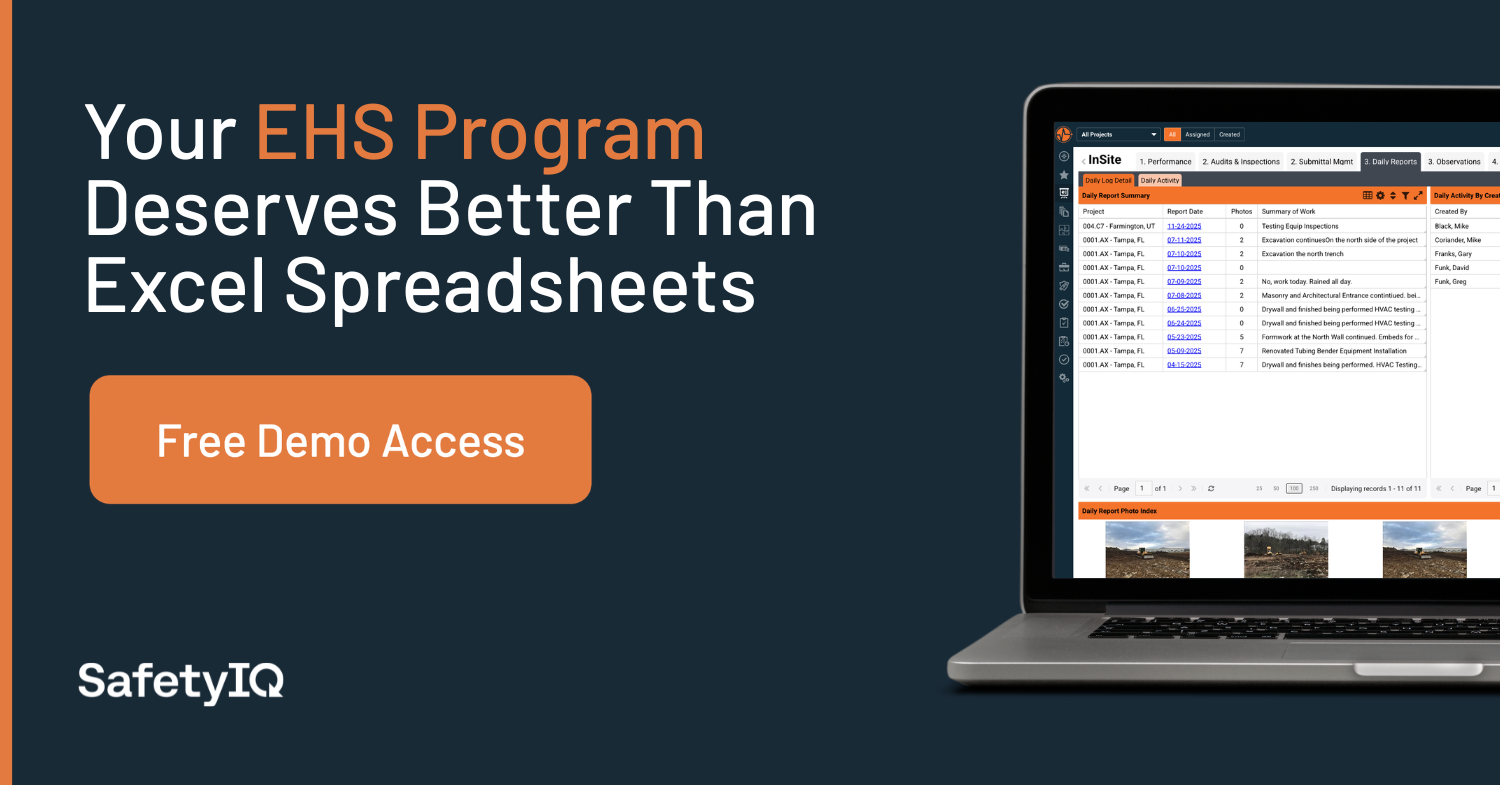
What EHS Software Actually Does Differently
Dedicated EHS software isn't just a fancier spreadsheet. It's a system built around how safety management actually works — real-time, collaborative, mobile, and connected to the workflows your team already follows.
Everything Lives in One Place
Incidents, near-misses, inspections, training records, corrective actions, compliance deadlines — all of it in a single system that everyone on the team can access. No more hunting through email threads or asking which spreadsheet is the most current one. When an auditor asks for documentation, you pull it up in seconds.
Real-Time Data, From Anywhere
Modern EHS platforms are cloud-based and mobile-friendly. A worker in the field can log a hazard from their phone the moment they see it. A supervisor in another state can see that report immediately. An EHS manager at HQ can monitor incident trends across all sites without waiting for weekly update emails. The information moves as fast as the work does.
Automated Reminders and Workflows
Instead of relying on someone to remember that a safety audit is due next Thursday, the software sends the reminder. Corrective actions get assigned automatically after an incident is logged. Training renewals get flagged before they lapse. The system does the administrative work so your team can focus on the actual safety work.
Reporting That Takes Minutes, Not Hours
EHS software generates reports on demand. Incident rates by site, training completion by department, open corrective actions by priority - all of it available with a few clicks. Presenting to leadership or preparing for an audit becomes a matter of pulling the report, not building it from scratch.
Signs Your Organization Is Ready to Make the Switch
Not every company needs to move at the same pace. But there are some clear signals that spreadsheets are no longer the right tool for the job:
- Your EHS team spends more time managing data than acting on it
- You've had compliance gaps or missed deadlines in the past year
- Incident data is scattered across multiple files or systems
- Field workers are logging safety information on paper and entering it later
- You're expanding to new sites or adding headcount
- Leadership is asking for safety metrics you can't easily produce
- You've had a close call that a better system might have caught earlier
If more than a couple of those sound familiar, it's probably time to have the conversation about dedicated EHS software.
What to Look for When Choosing EHS Software
Mobile Accessibility
If your workers can't use it from their phones on a job site, a lot of the value disappears. Make sure any platform you're evaluating works well on mobile, not just on a desktop browser.
Ease of Use
The most comprehensive EHS platform in the world is worthless if people don't use it. Look for something intuitive enough that workers without technical backgrounds can pick it up quickly. Complicated systems get abandoned.
Customizable Workflows
Every industry has different risks and different regulatory requirements. A construction company's EHS program looks different from a manufacturing facility's. The software should flex to fit your processes, not force you to adapt your processes to fit the software.
Integration With Existing Systems
If you're already using HR software, payroll systems, or other operational tools, your EHS platform should be able to connect with them. Data that lives in silos is still a problem, even if the silos are now software instead of spreadsheets.
Reporting and Analytics
Look for a platform that gives you out-of-the-box dashboards as well as the ability to build custom reports. You'll need both — the standard reports for day-to-day management and the custom ones when leadership asks a question that doesn't fit a standard template.
How SafetyIQ Makes the Transition Straightforward
SafetyIQ is built for organizations that are serious about safety and ready to move past spreadsheet-based management. The platform covers the full scope of EHS operations — risk assessments, incident reporting, journey management, compliance tracking, and more — in a single system that works on any device.
Customers who move to SafetyIQ typically see immediate time savings on administrative tasks. Risk assessments that used to take an hour to complete and file manually take minutes. Reports that required half a day to compile are available on demand. Automated reminders mean that nothing slips through the cracks during a busy month.
Downer Case Study: Before SafetyIQ, Downer was spending around 19 hours per month managing journey management through paper-based processes. After switching to SafetyIQ, they cut that down to four hours per month — freeing up time, improving real-time visibility, and reducing vehicle incidents across their operations.
The transition from spreadsheets to SafetyIQ doesn't require a long implementation project. The platform is designed to get teams up and running quickly, with support available throughout the onboarding process.
Frequently Asked Questions
Our spreadsheets are working fine right now. Why should we change?
It's a fair question, and the honest answer is: if your organization is small, your operations are simple, and your regulatory environment isn't demanding, spreadsheets might genuinely be enough for now. The problem is that "working fine right now" often means "no major incident has exposed the gaps yet."
Spreadsheets are static, manual, and fragile. They depend on people remembering to update them, not making data entry errors, and keeping them organized over time. That's manageable when one person owns the process and the volume is low. It becomes unreliable when the team grows, the number of sites increases, or the regulatory requirements get more complex.
The other issue is that spreadsheets don't give you early warning. A good EHS platform surfaces trends — rising near-miss counts in a specific area, overdue corrective actions, training gaps — before they become incidents. Spreadsheets don't do that unless someone is spending significant time analyzing the data manually. Most EHS teams don't have that time.
How disruptive is the transition from spreadsheets to EHS software?
Less than most people expect. The biggest concern teams usually have is data migration — what happens to all the historical records currently sitting in spreadsheets. Most EHS platforms, including SafetyIQ, support data import from spreadsheets, so you're not starting from scratch. Your historical incident data, training records, and compliance documentation can come with you.
The other concern is adoption — getting the team to actually use the new system. This comes down to two things: choosing a platform that's genuinely easy to use, and involving your team in the rollout rather than just announcing the change. When people understand why the switch is happening and see how it makes their jobs easier, adoption tends to go smoothly.
Plan for a few weeks of parallel running — keeping the spreadsheets active while people get comfortable with the new system — and then make a clean cut. Most organizations are fully transitioned within a month or two.
Is EHS software worth the cost for a mid-sized company?
The cost question is worth thinking through carefully, because the real comparison isn't "EHS software vs. free spreadsheets." It's "EHS software vs. the total cost of managing safety manually."
When you factor in the staff hours spent on data entry, reporting, and tracking compliance manually, the cost of a spreadsheet-based EHS program is usually higher than it looks. Add in the cost of a missed compliance deadline, a failed audit, or an incident that better data might have prevented, and the math shifts further.
Most mid-sized organizations that switch to dedicated EHS software see a return on investment within the first year — primarily through time savings and reduced incident costs. SafetyIQ's customers have documented savings of hundreds to thousands of hours annually depending on the size of their operations. Request a demo and we can walk you through what the numbers typically look like for a company your size.
Can EHS software handle industry-specific requirements?
Yes — and this is one of the areas where dedicated EHS software has a clear advantage over generic spreadsheets. Industries like construction, mining, oil and gas, manufacturing, and logistics all have distinct regulatory frameworks, risk profiles, and reporting requirements. A good EHS platform is configurable enough to reflect those differences.
With SafetyIQ, you can customize risk assessment templates, inspection checklists, incident report forms, and workflow triggers to match your specific industry and operational context. You're not forcing your safety program into a one-size-fits-all structure — you're building the system around how your work actually gets done.
If you operate across multiple industries or jurisdictions, that flexibility matters even more. The ability to run different workflows for different sites, while still rolling everything up into a single view for leadership, is something spreadsheets simply can't do.
What happens to our data if we stop using the software?
Data portability is something you should ask about upfront with any EHS software vendor. A reputable platform will let you export your data — incident records, inspection logs, training history, compliance documentation — in a standard format at any time. You should never be in a position where your safety records are locked inside a system you no longer control.
SafetyIQ supports data export so your records remain yours regardless of what happens down the road. It's also worth asking vendors about data retention policies, backup procedures, and what happens during the offboarding process. These aren't fun questions, but they're the right ones to ask before you commit.
The broader point is that moving to EHS software doesn't mean giving up control of your data — it means having better control of it, with more structure, better access, and a proper audit trail.
How do we get leadership buy-in to invest in EHS software?
This is often the hardest part of the switch, and it's worth approaching strategically. Leadership teams respond to numbers, so lead with the cost of the current system — not just the software subscription, but the staff hours spent on manual processes, the cost of compliance gaps, and the potential liability exposure from poor documentation.
It also helps to connect the investment to outcomes leadership already cares about: worker retention, regulatory compliance, operational efficiency, and liability reduction. EHS software isn't a safety department purchase — it's a business investment with measurable returns.
If you're hitting resistance, ask for a pilot. Run the software in one department or at one site for 90 days and track the time savings and data quality improvements. Real results from your own organization are more persuasive than any case study. SafetyIQ offers demos that can help you build the internal business case — bring leadership into one so they can see the platform and ask questions directly.
Making the Move
Spreadsheets served a purpose, and for a lot of organizations they were the right tool at the right time. But EHS management has gotten more demanding with more regulations, more data, more pressure to demonstrate that your safety program is working. A spreadsheet can't keep up with that, and neither can the team managing it. The companies that get ahead of this shift don't wait for a compliance failure or a serious incident to make the change. They look at what their current system can and can't do, decide they want something better, and make the move.
If you're ready to see what a purpose-built EHS platform looks like in practice, request a free SafetyIQ demo and we'll show you exactly what's possible.
SafetyIQ brings incidents, inspections, training, journey management, lone worker safety and fatigue into one mobile app. Tell us about your crews and sites for tailored pricing.

Corey Bruce is a seasoned executive with 20+ years of experience scaling revenue operations for private equity–backed EHS, SaaS, and compliance technology companies, currently serving as CEO of SafetyIQ.
Safety insights, straight to your inbox
New guides, monthly safety topics and SafetyIQ updates for EHS and operations leaders. Unsubscribe anytime.

Get a demo built around your sites, your teams, and the way your people work.
EHS, journey, and fatigue management software for field-heavy teams.

.png)

.png)